
Samurai Shodown
Also known as: Samurai Spirits (Japan)
Developer: SNK
| My Score | Avg. Score | ||||||
| 8.5 | 8.7 | ||||||
| Release Dates | |||||||
|
|||||||


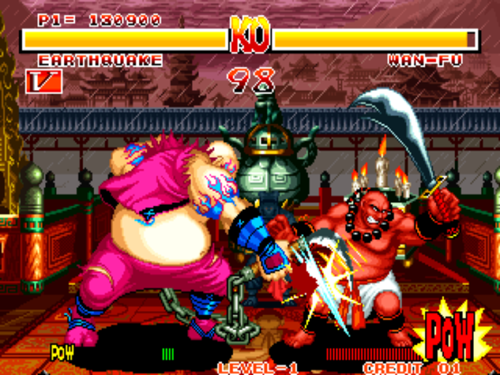
With the success of Street Fighter II, SNK had set out to create a fighting masterpiece of their own. Initial attempts with games like Fatal Fury and Art of Fighting were okay, but nowhere near the quality of Capcom’s classic fighter. Then SNK attempted a new strategy: instead of making a game that looked and felt like a clone of Street Fighter, they created a fighting game that looked, felt, and played differently. The end result was, in my opinion, SNK’s first great fighting game, Samurai Shodown. Set in feudal Japan, and titled with a play on words (hence the lack of the first “w” in Shodown), this game adds weapons to each character and blood, and was probably the most tactical fighting game available when it was released: if you simply attack, you’re going to lose. You need to take your time and be just as focused on your defense as you are on your offense. The gameplay is also set up in such a way that if someone lowers their guard for a moment, even if they have a full health bar and you’re one hit away from defeat, it’s not uncommon to be able to pull off a come-from-behind victory. This can be frustrating when the computer does it to you, but as you get better at the game, you’ll find yourself doing the same to the AI opponent in time as well. You can even disarm your opponent to drastically reduce their ability to harm you, forcing them to either fight with a handicap or attempt to reclaim their weapon. Toss in random power-ups that appear, like food to replenish someone’s health, as well as bombs to damage anyone unlucky enough to be nearby when they blow up, and you’ve also got an element of luck to add to the experience even more. I can’t say enough good things about Samurai Shodown. It really is a fantastic game…and as good as it is, SNK managed to improve on everything here in the sequel to solidify their standing as Capcom’s top competitor in the 2D fighting game market.
Review added: 12/27/2021
Samurai Shodown II
Also known as: Shin Samurai Spirits: Haohmaru Jigokuhen (Japan)
Developer: SNK
| My Score | Avg. Score | ||||||
| 9.5 | 9.0 | ||||||
| Release Dates | |||||||
|
|||||||
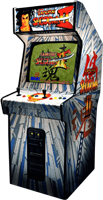
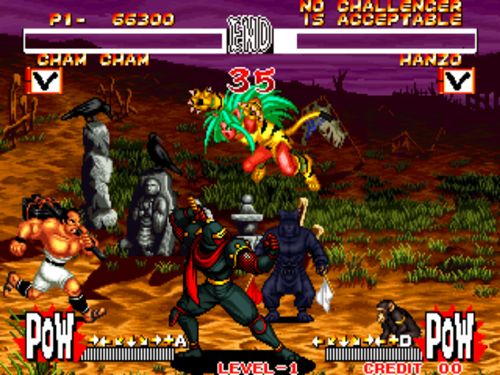
I enjoyed the original Samurai Shodown. It was a really good fighting game in its own right…Then SNK developed Samurai Shodown II and perfected the formula. While games like Street Fighter II were absolutely fantastic in their own right, they also were easy enough to play that button mashers could see the credits roll without needing to be too smart or tactical with their fighting. Samurai Shodown II, even on its lowest difficulty setting, is not a game where you'll get very far simply mashing buttons. Essentially, you'll want to be on the defensive just as much, if not more, than being on the offensive if you want to survive to see the wonderful, poorly translated cut-scenes and endings. Every now and then, power-ups appear on screen to help you (or your opponent) out during the battle, and at times you or your opponent may lose your weapon during the brawl, giving the person still with their weapon in hand a big advantage. The fighters also vary considerably in size: if you see the giant Earthquake against the dwarf-like Nicotine, it gives you a fun David vs. Goliath visual. And speaking of Nicotine, his full name is Nicotine Caffeine. This game is as addicting as both of those substances. A lot of people point to one of the King of Fighters games as what they believe to be the best fighting game that SNK has put out. I always point to this gem. I don't just consider it to be the best fighting game that SNK has ever put out, but I also consider Samurai Shodown II to be one of the best fighting games of all time.
Review added: 12/26/2022
Samurai Spirits
This game is listed on this website under a different name. To access the review, please click here.
Satan's Hollow
Also known as: N/A
Developer: Bally Midway
| My Score | Avg. Score | ||||||
| 8.0 | 7.3 | ||||||
| Release Dates | |||||||
|
|||||||
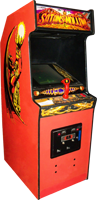
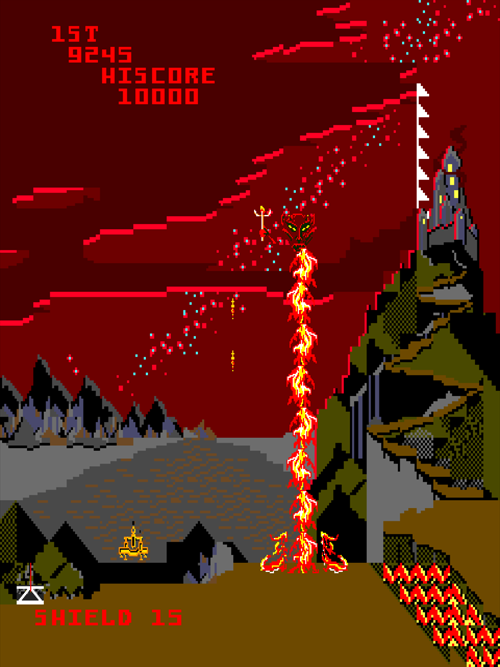
When it comes to games that follow the Space Invaders formula, Satan's Hollow may be one of my personal favorites. Instead of shooting in space, though, you're shooting in…well, I don't know exactly where. Perhaps an undisclosed place on Earth. Or perhaps it takes place in the homeland of ol' Satan. You see, in Satan's Hollow, the goal is not just to shoot down the enemies flying at the top of the screen, but to also build a bridge so that you can move on to a second screen where you battle Satan himself. The multitasking of shooting down enemy forces while also trying to build that bridge is a nice, unique take on the genre. My only real gripe with it is that the battle with Satan is…well, underwhelming. I was hoping for a battle against a foe that takes up much of the screen, like in Phoenix, but instead Satan is a puny little fellow. He is a bit more difficult to hit than other enemies due to his speed and the giant pitchforks that he hurls at you, but he also goes down with one shot like other enemies do. Aside from the underwhelming battle with Satan, you'll also battle gargoyles, egg droppers, and the odd enemy choice of "Satan's Head." Gargoyles circle the top of the screen, but will also attempt to dive-bomb you, as well as steal your ships (lives). So, while you're trying to build that bridge, if you aren't paying attention, you may find yourself with one less life to work with. The egg droppers are basically pterodactyls or dragons…we'll just say flying lizards. They drop "flaming eggs of fire" down at you, which explode as they hit the ground. "Satan's Head" is what it sounds like: the floating head of Satan that hovers back and forth on the screen, breathing pillars of fire at you. Satan also clearly has an ego, since his head grows larger the longer he stays on the screen. You should make him pay for getting a big head. Anyway, Satan's Hollow is a solid game with an interesting take on a formula that had been done over and over before it. If it had been released a year or two earlier, I'd probably consider it to be an all-time classic. As it is, though, I just think of Satan's Hollow as a good game that managed to breathe a little more life into a genre that was beginning to feel stale.
Review added: 08/20/2026
Scrabble
This game is listed on this website under a different name. To access the review, please click here.
Scramble
Also known as: Astro Ambush (Bootleg), Bomber (Bootleg), Explorer (Bootleg), Impacto (Bootleg), Kamikaze (Bootleg), New Century (Bootleg), Offensive (Bootleg), Scrabble (Bootleg), Space Mission (Bootleg), Space Trek (Bootleg), Strafe Bomb (Bootleg)
Developer: Konami
| My Score | Avg. Score | ||||||
| 7.5 | 7.2 | ||||||
| Release Dates | |||||||
|
|||||||
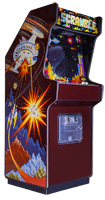
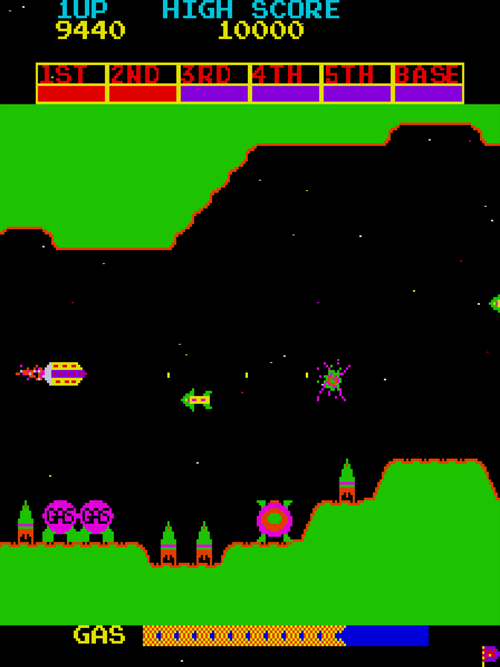
Scramble is one of those successful, critically acclaimed arcade games that spawned a TON of bootleg copies (see the list above), and yet a lot of people these days have never heard of it. Konami's side-scrolling shooter may have been the first in the genre…and if not the first, it was one of the first, and it was Konami's first big hit that helped lead them into transforming into the powerhouse in video games that they would become. When compared to games that would come later in the genre, Scramble feels a bit slow-paced and easy, but it was also a pretty well-made game for the time, gradually introducing new players to new aspects of the game. To start, you've mostly got enemies at the bottom of the screen, so if you try to shoot forward, you won't be able to hit most of them. A second button, however, drops bombs on enemies below. It takes a little practice to get the timing down so that these attacks actually land where you intend them to land, but once you get it, it can be fun switching back and forth between bombing enemies below while sniping off the enemies coming in from the air. Another unique concept is that the enemies aren't the only thing that you're trying to survive against: you're also trying to survive the terrain. The levels have mountains and obstacles in the environment where if your aircraft happens to hit one, you've lost a life. Likewise, you're also battling your fuel tank, which needs to be topped off so that you can maintain flight. In an odd choice, you obtain fuel by blowing up fuel tanks scattered around the levels…I don't understand how destroying your source of fuel provides you fuel, but perhaps the creators were just a bit Scramble-brained…sorry, I'll continue on. Scramble has six different sections, and once you complete them, like most arcade games of the time, you get to play them all over again in a loop, but with slightly increased difficulty. Anyway, Scramble may not be the most memorable scrolling shooter that you'll play, or the best, but for its time, it was a neat concept and it helped lay the groundwork for all future scrolling shooters that would come after it.
Review added: 04/09/2026
Sea Wolf
Also known as: N/A
Developer: Midway
| My Score | Avg. Score | ||||||
| 8.0 | 7.2 | ||||||
| Release Dates | |||||||
|
|||||||
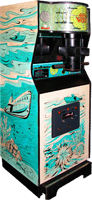
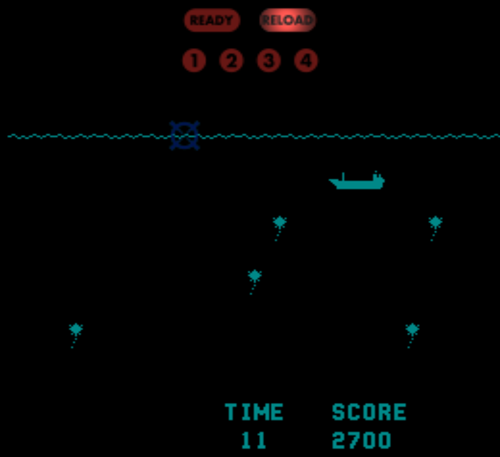
Sea Wolf was one of the most successful early arcade games. It was the highest-grossing game in 1976 and 1977 in the United States. It has kind of a neat gimmick to it, too. If you're playing at an actual arcade cabinet, you grab ahold of the periscope and look inside it to play. The right handle has a button that you can use to shoot torpedoes up at any ships passing by. The periscope itself swivels left and right, allowing the player to move their aiming crosshairs on the screen. As you play, various types of aquatic vehicles will pass by at different speeds. Your goal is to time your shots and blow as many of those ships out of the water as you can within the time limit. Aside from doing your best to time your shots to hit the enemy subs and boats, there are also underwater mines that may get in your way. Blowing up a mine doesn't hurt you, but it does prevent you from scoring. The neat periscope gimmick on the arcade cabinet and the feeling of "I can do better next time" that it leaves the player with are likely much of the reason for this game's success. It's a solid, early arcade game, and while it's not horrible to play on an emulator, it really needs to be played on the original arcade cabinet to really understand why Sea Wolf was so popular.
Review added: 11/11/2025
Sea Wolf II
Also known as: N/A
Developer: Midway
| My Score | Avg. Score | ||||||
| 6.5 | 6.9 | ||||||
| Release Dates | |||||||
|
|||||||
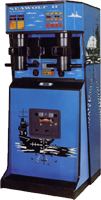
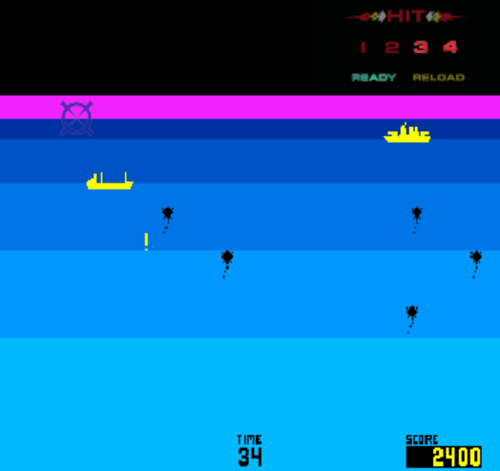
Sea Wolf was a big success at arcades, so it's only natural that Midway would want to capitalize on that and make a sequel. While Sea Wolf II provides a very welcome addition of a two-player mode, the addition of a second periscope makes the arcade cabinet look more like a fancy coffee machine than anything else. If Sea Wolf II could make me a latte while I played, maybe I'd like it a bit more. Anyway, the original Sea Wolf was simplistic, but it was designed well for an early video game, and the gimmick of the periscope to both control the action and see the screen helped make it stand out. When Sea Wolf II came out, two years had passed, and while Sea Wolf was still popular at the arcades, people weren't popping in quarters like they had in previous years. According to the November 1978 edition of Play Meter magazine, Sea Wolf had dropped from the number one highest-earning arcade game to number three. Sea Wolf II came in at number four…even during its initial year, it seemed to fail at living up to the original. Anyway, aside from adding a second player, Sea Wolf II seems to try applying an illusion of 3D gameplay…the end result, for me anyway, was an easier game that didn't really motivate me to play again like the original Sea Wolf did. It's still a passable game for its time, and the periscope use is still a fun gimmick if you're playing on an original arcade cabinet…but Sea Wolf II just doesn't live up to the original, in my opinion.
Review added: 11/11/2025
Seesaw Jump
This game is listed on this website under a different name. To access the review, please click here.
Shin Samurai Spirits: Haohmaru Jigokuhen
This game is listed on this website under a different name. To access the review, please click here.
Sheriff
Also known as: Bandito (Original North American release name)
Developer: Nintendo
| My Score | Avg. Score | ||||||
| 9.0 | 7.2 | ||||||
| Release Dates | |||||||
|
|||||||
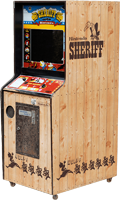
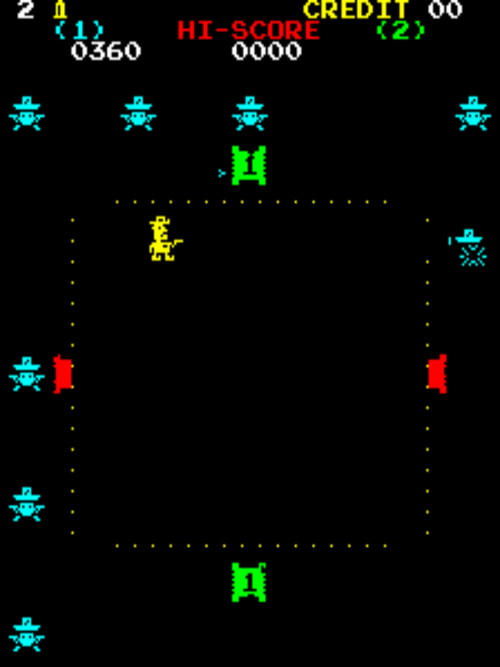
Sheriff, also known as Bandito, was an early Nintendo arcade game that helped show that the future industry juggernaut could come up with some unique ideas of their own. Sheriff was a unique take on the popular shooter genre of the time. Like most games in the genre at the time, you've got enemies at the top of the screen and you're controlling someone (a sheriff in this case…fitting) as they attempt to shoot at them. The catch here is that you're not only dealing with enemies at the top of the screen. You're surrounded on every side of the screen. Essentially, the game concept is that the area that the sheriff is able to navigate in is actually a town, with fences and barricades put up around the area. The bandits have surrounded the town and are trying to get in. On top of that, a "beauty" has been kidnapped by the bandits and is waiting for you to save her. This isn't just a slow game of shooting at stationary bandits, though. Sixteen bandits will slowly circle the town…and if you're not quick enough, they'll sometimes hop over the barricades, resulting in some close-quarters shooting. In typical fashion for a shooting game of the time, there's also a condor that flies at the top of the screen at times that you can shoot for double points…it's good to know that our hero is willing to take a break from shooting bad guys to spot a bird minding its own business and drop it from the sky. The ultimate goal of the game is to continuously clear out the bad guys and rescue the constantly kidnapped "beauty." According to the arcade flyer, then "love grows between the two." When that love has grown, the player is rewarded with a doubled score. The gameplay of Sheriff is good fun for the time, with the ability to shoot up, down, left, right, and diagonally…and you're punished for inaccurate shooting: shoot blindly and you'll find yourself quickly breaking down the walls that are keeping you safe from enemy fire. My only real complaint about this game is something that was likely seen as a fun novelty in 1979, and that's the background music that plays non-stop. It's the musical equivalent of stubbing your big toe while someone puts a bucket over your head and someone continuously beats that bucket with a boat oar. Sometimes you zone out the sounds to focus on your toe, but that annoying sound always becomes the focus again eventually. Overall, Sheriff (also released in the US as Bandito) is a very, very good shooter with a very unique take on the genre for the time. If you're a fan of older video games, then Sheriff is worth checking out. Its innovation within the Space Invaders-dominated genre of the time reflects how Nintendo has always been one to think a little bit outside of the box.
Review added: 02/22/2026
Sky Diver
Also known as: N/A
Developer: Atari
| My Score | Avg. Score | ||||||
| 8.0 | 7.1 | ||||||
| Release Dates | |||||||
|
|||||||
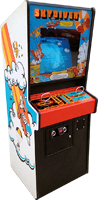
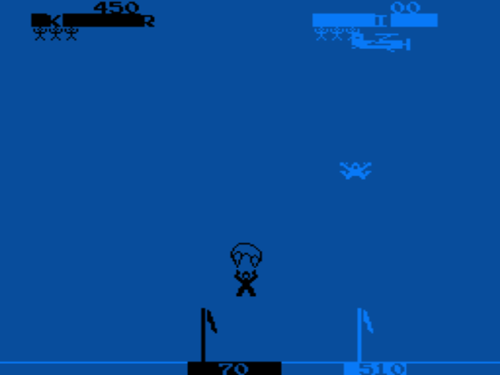
Sky Diver was an early arcade game released by Atari in 1978. The concept of the game is simple…you are a sky diver competing against a rival sky diver. At the bottom of the screen, you'll see black and white landing pads. Your goal is to land on the appropriate landing pad, with your parachute open for a safe landing. The catch is that if you open your parachute early, you'll have a greater chance to score, but the points you receive will be lessened. If you wait until the last minute to pop open that parachute, then you'll gain the maximum amount of points, but at the risk of either missing the landing pad or not getting your parachute open in time…and when the latter happens, you'll hear sirens and see an ambulance roll on screen to take your crippled carcass away. Randomly, as you play, after successfully landing in the proper zone, you may obtain a letter at the top of the screen. If you manage to spell out SKYDIVER, then you'll receive a double score bonus. As one might expect from an arcade game of the time, the gameplay is extremely simplistic, but it's pretty addicting for what it is. If you've got a few minutes to kill and you give Sky Diver a chance, you may find yourself trying to perfect your sky diving skills for much longer than you anticipated. I definitely did.
Review added: 11/18/2025
Sky Skipper
Also known as: N/A
Developer: Nintendo
| My Score | Avg. Score | ||||||
| 6.5 | 5.9 | ||||||
| Release Dates | |||||||
|
|||||||
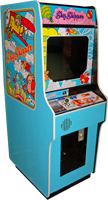
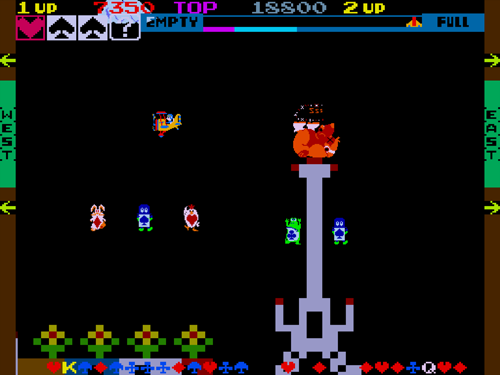
Who doesn't want to rescue a bunch of cute, cuddly animals? Nintendo thought the same thing. So, when they developed Sky Skipper, they had you piloting a biplane with the goal of rescuing all of the animals in the level…except for the gorillas. In an odd design choice, instead of creating a monster or some sort of dastardly villain, Nintendo made gorillas the enemy here. So, you're saving animals by harming animals, basically. The animals that you are supposed to save are locked up in cages. To release them, you need to drop a bomb on a gorilla, which dazes the poor primate, knocking it on its hiney. With the ape down, the cage door opens, and the animals escape. You then need to glide down, without touching any part of the stage, and graze over the released animals to rescue them. When the gorilla regains its senses, it will jump back to its feet and the cages will be locked again, so you've got to make your rescue quick. You can lose a life by running into parts of the level, getting caught by the gorilla, or running out of fuel. The fuel is replenished by picking up one of each kind of animal: duck, rabbit, cat, and turtle. Sky Skipper didn't seem to be received well in arcades, neither in Japan nor in the United States, but despite that, a port was still made for the Atari 2600, and the arcade game was later re-released in 2018 as part of the Arcade Archives series on Nintendo's Switch console. Overall, Sky Skipper is a passable game, but it's nowhere near the quality of game that Nintendo established with Donkey Kong or would later be known for with its Famicom/Nintendo Entertainment System, which is likely a large reason why it's a game that is mostly forgotten about today.
Review added: 08/20/2026
Snap Jack
Also known as: N/A
Developer: Universal
| My Score | Avg. Score | ||||||
| 6.0 | 6.2 | ||||||
| Release Dates | |||||||
|
|||||||
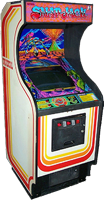
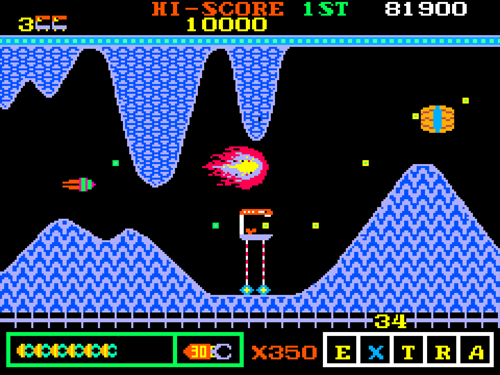
In 1981, Scramble was a popular game in the arcades. In 1981, Pac-Man was still plenty popular in arcades after debuting the previous year. Someone over at Universal saw this and said to themselves, "You know, if we could throw Scramble and Pac-Man in a blender, I bet the result would be a cash flow smoothie!" Nobody had the heart to tell this individual that cash flow smoothies don't exist. I think you'd get a stomach ache from slurping currency through a straw. Anyway, Universal still attempted to make their cash flow smoothie, and the result was Snap Jack, a game where you control a vehicle that eats pellets through automatic, side-scrolling stages. Like in Scramble, the stage scrolls, with both the ground and the ceiling rarely being flat. You're able to move your vehicle forward and backward on the screen as it scrolls, and this is necessary to avoid all of the obstacles that obstruct your way. The vehicle can also increase the height of its legs, which allows you to avoid enemies on the ground and enables the vehicle to nibble away at the pellets in the air. Getting as many pellets as possible is key to survival. Every pellet that reaches the right-hand side of the screen transforms into a squid-like creature, giving you more obstacles to avoid and overcome. If you manage to come across a power pellet and get the vehicle to consume it, then you'll be treated to the theme of Popeye the Sailor Man while your car detaches from its wheels and flies around the screen, eating any enemies still on it, if you're able to catch them. While attempting to eat enemies, the letters E, X, T, R, and A briefly flash on the screen in different locations. If you're able to collect one of each letter, then you'll be granted an extra life. Upon reaching the end of a stage, you'll have to jump the vehicle across a large body of water, bouncing on a few trampolines along the way, and the greater the distance you're able to jump, the better the reward you'll receive. Snap Jack has an interesting concept behind it, and once you get used to it, it can be kind of fun, but it also feels a bit awkward to play at times. Ultimately, the mixture of Pac-Man and Scramble is a neat concept that simply doesn't result in a game anywhere near the quality of Pac-Man or Scramble. Still, if you appreciate developers thinking outside the box and trying something new, then you may find something to appreciate in Snap Jack.
Review added: 08/20/2026
SOS
Also known as: N/A
Developer: Namco
| My Score | Avg. Score | ||||||
| 4.5 | 4.7 | ||||||
| Release Dates | |||||||
|
|||||||

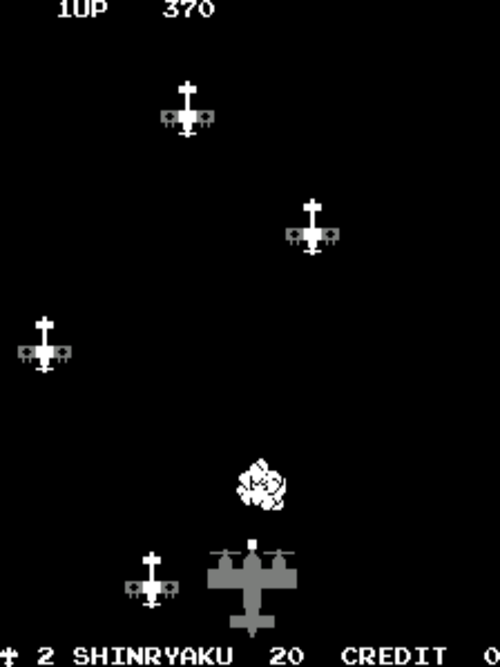
SOS was a Japanese-exclusive arcade game developed by Namco…and it's not very good. It's got an interesting concept, though. Basically, at the bottom of the screen is the word "shinryaku." Shinryaku, in Japanese, means invaders. So, basically, there's a counter next to shinryaku. If that counter reaches 100, it's game over. That counter increases if an enemy plane manages to fly past you without you shooting it down. However, while you're trying to shoot down these planes, you'll get the Morse code "SOS" sound and signal appearing on the left or right side of the screen. If you maneuver your plane over to that SOS call, you'll get an extra 30 points and the shinryaku counter will decrease by 9, making up for any planes that may have gotten past you. The catch with this game is that you can only fire one bullet at a time…and if you're moving while firing, your bullet will fire at an angle instead of straight forward. The concept of this game is pretty solid…the problem is the game's speed. It's dreadfully slow-paced…and even with the slow speed, the game will bombard the screen with shinryaku planes, so it's near impossible not to let many of them fly by as you play…at least not until you get used to the angled shooting aspect. Another interesting tidbit is that this may be the first game to contain nudity…if you're wondering where nudity would fit into what I just described, well, after you score 2,000 points, you'll see the words COFFEE BREAK along with a gal in a bikini. After you obtain 6,000 points, that gal will be topless. After you get 10,000 points, the gal is only wearing her birthday suit. It's not a graphic visual…the lady is cartoony, but it's still surprising that such a thing would be included in a game put in arcades…then again, I can't imagine too many folks would be willing to sit through this game long enough to see it.
Review added: 11/18/2025
Space Fury
Also known as: N/A
Developer: Sega
| My Score | Avg. Score | ||||||
| 7.0 | 7.0 | ||||||
| Release Dates | |||||||
|
|||||||
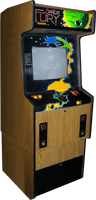
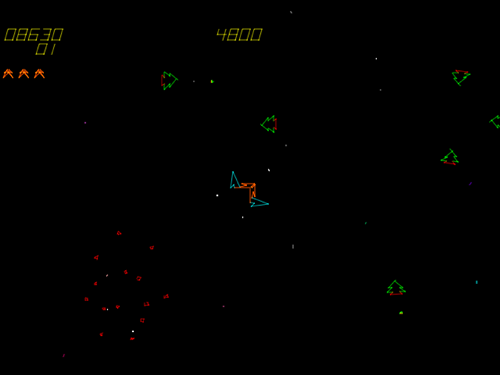
We've all played Asteroids and thought to ourselves, "Y'know, shooting big rocks is fun and all, but I'd really just like to shoot at spaceships commanded by aliens that look like cycloptic lightbulbs that have veins bulging out of their foreheads and pretty red lips." Well, Sega/Gremlin heard that overwhelming demand from players in 1981 and gave us Space Fury. After you plop a quarter in the arcade cabinet, Space Fury begins with the pretty-mouthed space alien appearing on the screen and saying, "So! A creature for my amusement. Prepare for battle!" You are then thrust into battle. Space Fury controls like Asteroids, as I hinted at earlier, but the ship inertia is reduced a bit here, making Space Fury feel a bit easier to pick up and play without needing to get used to how far your ship will drift if you need to hit the gas to avoid an incoming danger. If you hope to survive in Space Fury, you can't just find a "safe" spot and try to pick off as many enemies as possible, so ship movement is necessary. The enemy ships are often faster than asteroids were, and those floating rocks didn't shoot at you. If the idea of facing these odds while controlling a tiny ship with low firepower sounds underwhelming, Sega/Gremlin thought so, too. That's why after you complete each round, you have an opportunity to fit your ship with one of three upgrades. One upgrade shoots three shots in front of you rapidly, one upgrade shoots two shots in front of you and one shot behind you, and the last upgrade shoots in front of you as well as to your left and right. Snapping into one of these upgrades gives you bonus points; however, once you complete that stage, the upgrade is lost and you'll either need to pick one of the remaining upgrades or choose to battle without an upgrade. On the positive side, if you die on a stage with an upgrade, you still respawn with the upgrade equipped until you are either able to complete the stage or run out of lives. Overall, Space Fury is a decent game for its time. It's got an interesting take on the Asteroids formula from a few years prior, and the synthesized comments between each level were a nice novelty for players in the arcade, too. Space Fury didn't have the same impact that Asteroids did, nor was it as impressive for 1981 as Asteroids was for 1979. But Space Fury is still a solid game in its own right...and what other game has a lipstick-wearing, cyclops alien warmonger taunting you between rounds?
Review added: 09/01/2026
Space Invaders
Also known as: Alien Invasion Part II (Bootleg), IPM Invader (Bootleg), The Invaders (Bootleg)
Developer: Pacific Kougyou
| My Score | Avg. Score | ||||||
| 9.5 | 8.3 | ||||||
| Release Dates | |||||||
|
|||||||

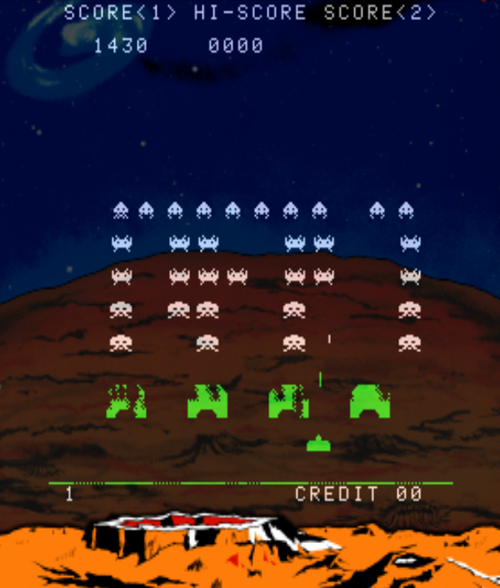
In Japan, in the mid-70s, games like Breakout were very, very popular. Tomohiro Nishikado, a fan of Breakout, liked the game, but wanted to create something better. The goal was to create a sense of achievement from destroying targets, one at a time, like in Breakout, while combining it with elements of a target shooting game. The end result was that instead of bouncing a ball around to hit static targets, the player would control a ship and shoot at moving targets. Taking things further, Nishikado felt that there were other elements lacking in video games, and he aimed to correct them in Space Invaders. First, he wanted to ensure that enemies returned fire: you weren't just shooting at helpless targets. You were in danger, just like they were. He also removed the timer: most arcade games up until then used a timer when you popped a quarter in. When the timer ran out, so did your game. Instead of a timer, a set number of lives were introduced. If you lose your lives, then your game is over. Also acting as a timer, of sorts, were the aliens themselves, gradually dropping to the bottom of the screen like grains of sand in an hourglass. The end result was, for its time, a masterpiece of a game. Within a year of its release, Space Invaders was the all-time best-selling arcade game and it remained the top arcade game for a few years afterward, grossing over two billion US dollars by 1982…that's nearly seven billion dollars in 2025 money. While games like Galaxian and Galaga would later come along and perfect the formula created in Space Invaders, it's hard to deny how important and successful this game was. It wasn't just an insanely popular game**;** it was also one of the most influential video games ever created.
Review added: 11/11/2025
Space Invaders Galactica
This game is listed on this website under a different name. To access the review, please click here.
Space Mission
This game is listed on this website under a different name. To access the review, please click here.
Space Trek
This game is listed on this website under a different name. To access the review, please click here.
Spiders
Also known as: N/A
Developer: Sigma Ent. Inc.
| My Score | Avg. Score | ||||||
| 7.0 | 6.8 | ||||||
| Release Dates | |||||||
|
|||||||
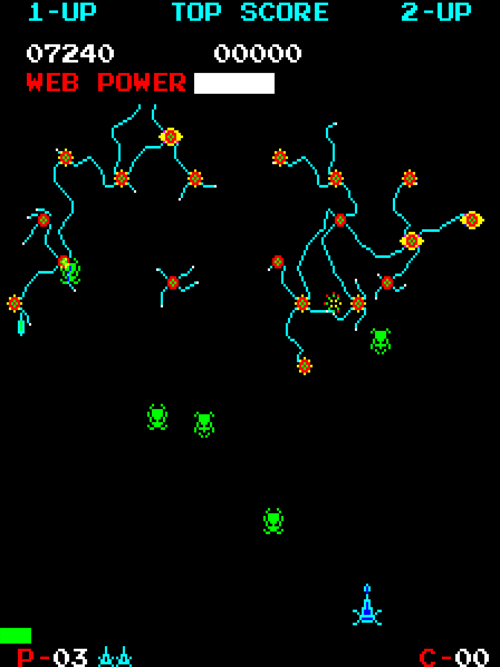
Spiders is a bit of an oddball game. It starts out cool enough: if you watch the demo play prior to inserting a quarter, you'll see a small spider grow into a giant one, looking bright and cartoony. From there, if you plop a quarter in the machine, you'll begin to play a game inspired by the Space Invaders-style shooters. Now, from here, I'm not sure what to think. The arcade flyer says that this game takes place in outer space…but it also says that you are controlling a gun at the bottom of the screen rather than a spaceship. So, either you're in the outer spaces of a garden in a backyard, or you're an astronaut in a jetpack, zooming around space shooting space bugs. I suppose that the flyer also says that the goal is to prevent the spiders from reaching Earth, so I guess the jetpack option is likely the one…either that, or spaceship and gun are the same thing to the person who wrote the flyer. Anyway, sorry. I got sidetracked. You control a gun at the bottom of the screen that can only move left and right. Your goal is to shoot down all of the spiders that begin to crawl down towards you. If they get past you, then they make it to Earth. Aside from the spiders, though, you want to shoot down the seeds, cocoons, and spider eggs that make up the ever-growing web at the top of the screen. Eventually, you'll get super webs shooting out at you, which almost look like a long frog tongue, as well as some firepower that looks like a collection of waves that you'll need to avoid along with the spiders. Once all aspects of the web have been destroyed, you'll be left with one single white spider that you'll need to take down to complete the level. Between levels, you'll be rewarded with a simple but catchy little jingle. If you advance far enough into the game, you'll see "Space Mona Lisa" with an odd jingle of her own…the flyer says to imagine what you'll see after advancing further. I'll spoil it for you: more Space Mona Lisa. Except instead of it being a still portrait, Space Mona Lisa may blink at you, move her mouth, and/or contort her nose in a way that makes you think that Space Mona Lisa may have taken a space punch to the face. Eventually, the skin color of Space Mona Lisa also changes, and then she seemingly loops the weird facial reactions again until she sheds her skin for a new skin hue to loop the facial reactions for another cycle. Anyway, Spiders is a solid shooter for its time. While it's clearly inspired by other shooters of the time, it also feels pretty unique. That originality helps it stand out a little bit, even if it didn't seem to get the recognition that some other, more popular games of the time got. If you're a fan of single-screen shooters, then I definitely recommend giving Spiders a try…you wouldn't want to make Space Mona Lisa sad, would you?
Review added: 09/02/2026
Star Crest
This game is listed on this website under a different name. To access the review, please click here.
Strafe Bomb
This game is listed on this website under a different name. To access the review, please click here.
Street Fighter
Also known as: N/A
Developer: Capcom

| My Score | Avg. Score | ||||||
| 6.0 | 6.0 | ||||||
| Release Dates | |||||||
|
|||||||

For those unaware, the Street Fighter franchise didn’t exactly burst onto the scene with an excellent game...On the contrary, the original Street Fighter is just a barely passable experience that most fighting fans today would likely stick their noses in the air at. Though, in fairness, if the controls were a bit tighter, I do kind of enjoy how matches can potentially end in one or two hits if you’re able to pull those hits off without your opponent blocking. It’s kind of neat uppercutting my opponent to victory just as they’re lunging at me with an attempted move of their own. Anyway, with only one playable character, Ryu, the original Street Fighter didn’t really have much reason to replay the game upon beating it. Don't get me wrong, Ryu is a fun character to play as: there's a reason that he's been a playable character in every edition of the Street Fighter franchise…but as the old saying goes, "Variety is the spice of life," and Street Fighter is about as spicy as vanilla ice cream. I must admit, though, you can TECHNICALLY also play as Ken in this game…however, only in a two-player battle against a friend, and original Street Fighter Ken is an exact clone of Ryu, aside from his appearance…So maybe this game is as spicy as vanilla ice cream with vanilla wafers crumbled on top. Only diehard Street Fighter fans wanting to see the origin of the series should bother with this game...Though, for those who do play through, expect to see some familiar faces (like Sagat, Adon, and Birdie) amongst the never-seen-again fighters (like Retsu, Joe, and Lee) while you fight around the world uppercutting those poor saps that think that they've got the upper hand…and I guess they technically do: Ryu's upper hand in their upper jaw. It's just a shame that after so many "uppers" in that last sentence, I have to say again, in closing, that the original Street Fighter is a bit of a downer.
Review added: 08/29/2019
Street Fighter II: The World Warrior
Also known as: N/A
Developer: Capcom
| My Score | Avg. Score | ||||||
| 9.5 | 9.2 | ||||||
| Release Dates | |||||||
|
|||||||
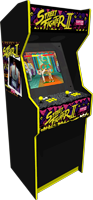
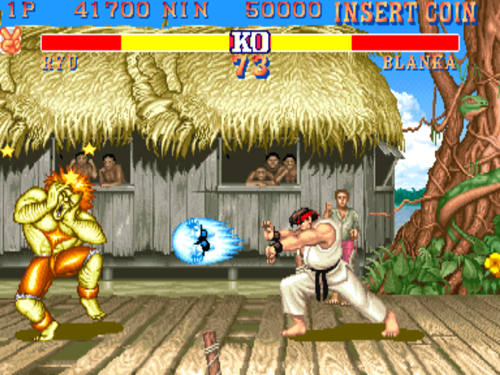
By the 1990s, arcades weren't what they used to be here in the United States. Home gaming consoles had flourished, and it wasn't very easy to find an actual arcade…the typical local arcade was basically the corner of a pizza shop, bowling alley, or truck stop with maybe four or five cabinets sitting side-by-side. Well, at least that's how it was where I was growing up at the time. While people still played arcade games in the United States, I don't know if anyone really expected a game to catch on fire like they did back in the '70s and '80s…and then Street Fighter II came along. Street Fighter II extended the life of the arcade market, supposedly taking in over ten billion dollars in total revenue as of 2017, putting it only behind Space Invaders and Pac-Man…and those two games had an extra ten years of being in arcades. Street Fighter II's success was pretty easy to understand as soon as you played it for the first time. It was far and away the greatest fighting game that had ever been created up until that point. It was so good that, within a year or two of hitting arcades, just about every video game publisher that existed was trying its hand at putting out a fighting game…and the vast majority of them couldn't come anywhere near the quality of this gem. Basically, Street Fighter II improved on the original Street Fighter in every possible way. You could choose to fight as one of eight different fighters, instead of only being stuck with one like the previous game. Aside from the variety of fighters, which encouraged players to play this game over and over with each fighter…and in some cases, simply play over and over just to perfect one single fighter…the gameplay was tweaked so that everything played silky smooth. Hit detection feels great, movements are fluid, and the gameplay mechanics are so simple that Street Fighter II is a game that's easy for a newcomer to get into, but also deep enough that it takes time to master. Later variations of Street Fighter II tweaked this game to perfection, but the original release of Street Fighter II was almost there already.
Review added: 11/20/2025
Super Breakout
Also known as: N/A
Developer: Atari
| My Score | Avg. Score | ||||||
| 8.5 | 7.6 | ||||||
| Release Dates | |||||||
|
|||||||
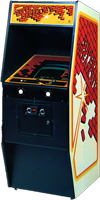
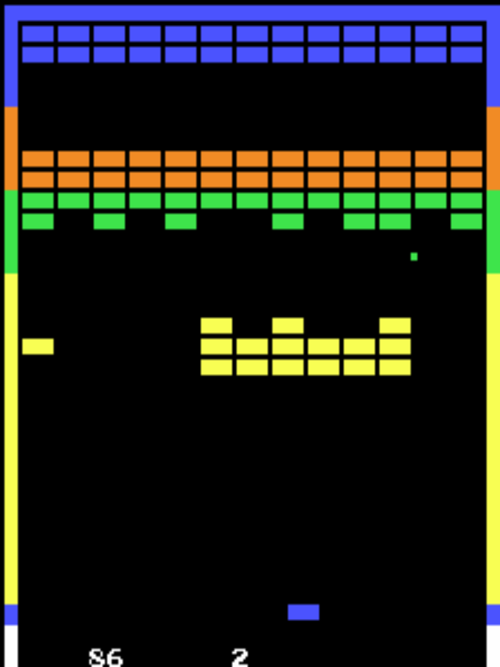
Breakout was a hit for Atari and very successful at the arcades, so it only seems natural that a sequel would be made to capitalize on its popularity. Thus, Super Breakout was born. Not content to just be a single game, Super Breakout actually had three different game modes for you to play, and you were able to choose which variation you wanted to play using a rotary dial on the cabinet. The first variation, labeled "Double," had you controlling two paddles that are parallel to each other while you tried to keep two balls in play as long as you were able to. The next mode, labeled "Cavity," plays like normal Breakout, except that you'll see two cavities on the screen with balls bouncing around inside. Your goal is to break through to free those balls so that you'll have multiple balls in play to destroy as many blocks as possible. The best of the bunch, in my opinion, is labeled "Progressive." In this mode, it's your basic Breakout formula, but with a twist: the blocks at the top of the screen aren't stationary. Those blocks will gradually drop towards the bottom of the screen, making it harder and harder to keep that ball in play…especially after the ball has built up a bunch of speed. The end result is a game with plenty of reasons to continue popping quarters in: if you master one game, you've got two more to try to conquer. While Super Breakout never quite seemed to reach the popularity of the original game, it's still a very fun game in its own right. If you're a fan of bouncing balls around a screen to break a bunch of colored bricks, then Super Breakout is a game that'll definitely keep you coming back for more.
Review added: 11/09/2025
Super Cobra
Also known as: N/A
Developer: Konami
| My Score | Avg. Score | ||||||
| 8.0 | 7.5 | ||||||
| Release Dates | |||||||
|
|||||||
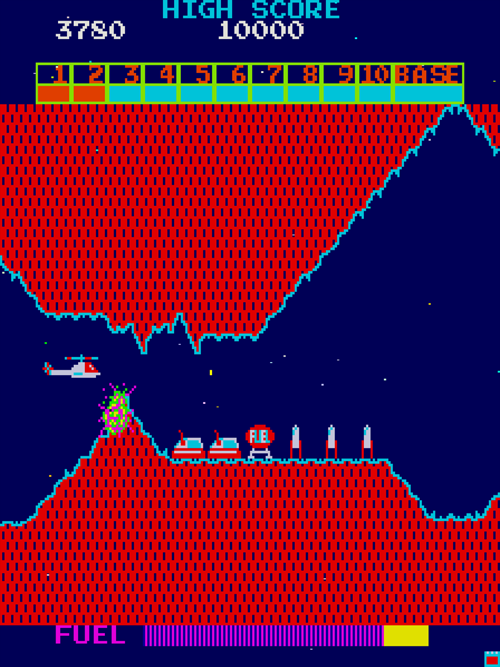
Super Cobra didn't come out very long after Scramble, and it's a very similar game in terms of gameplay…but it feels a bit more polished than Scramble was, both in terms of looks and gameplay. Adding a bit to the challenge of the game, Super Cobra has the player controlling a helicopter through ten scrolling stages, while shooting forward and dropping bombs below in an effort to combat the enemy turrets, tanks, rockets, and UFOs. Like in Scramble, your fuel is limited, so you need to blow up those fuel tanks on the ground so that some of it splashes up into your fuel tank afterward…I guess that's the logic for eliminating the thing you need from the screen? Anyway, while Scramble came first, I think Super Cobra is a bit more well-known…likely in part due to the fact that it was ported to pretty much every home console and home computer of the time. Anyway, like I mentioned earlier, though, Super Cobra is very much just a spiritual successor to Scramble, with minor tweaks added. If you prefer less of a challenge, then you may prefer Scramble to Super Cobra. If you like a challenge, and you've got a stack of quarters ready when playing an arcade game, expecting to use 'em, then Super Cobra may be more up your alley. Whichever way you go, though, both early Konami scrolling shooters, while dated today, were very good for their time and important foundations of the scrolling shooter genre that would take over arcades and home consoles/computers in the decades to come.
Review added: 08/02/2026
Super Locomotive
Also known as: N/A
Developer: Sega
| My Score | Avg. Score | ||||||
| 6.0 | 6.2 | ||||||
| Release Dates | |||||||
|
|||||||
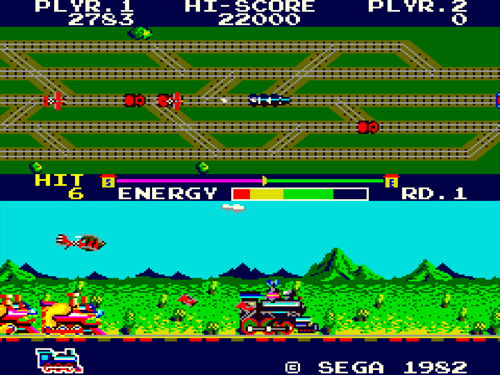
I've always liked Sega since it has traditionally been a company that was willing to publish games that felt more experimental than established. Super Locomotive is definitely one of those experimental-feeling games. In this game, you control the locomotive of a train. Your goal is to switch focus between the upper half of the screen and the lower half of the screen. The upper half of the screen shows all of the train track patterns, showing you where you can switch to a different track and showing your locomotive from a top-down perspective, as well as any incoming enemies or dangers. The lower half of the screen shows the locomotive from a side view, allowing you to accurately time any efforts to destroy any bombs or missiles that have been fired at the locomotive. How does a locomotive destroy bombs and missiles, you ask? With puffs of steam, of course. You can also set up a force field that changes the color of the locomotive and makes it invincible for a short time, while also speeding the locomotive up while in use. Using the force field or the puffs of steam will deplete your energy bar, but plowing through oil towers will refill the bar. So, you'll want to be looking at the top of the screen to determine which path will get you to some oil while also watching the bottom half to ensure that your locomotive doesn't go kaboom while you attempt to refill your energy bar. The theme music is pretty catchy and found its way into my head to the point where I found myself hearing it while fixing stuff at work. Anyway, as much as I admire that Sega tried something completely different, new, and unique here, there's a reason that it didn't really become a hit. While not a bad game, it's not really the typical arcade game where you can jump in and understand what to do quickly. Super Locomotive takes some time to learn...and in an arcade setting, that means you've got to spend quarters in order to learn it. But, while Super Locomotive remained an arcade exclusive for a few decades, back in 2022 when Sega released the Genesis Mini 2, it included a Genesis port of the game for the first time ever. Anyway, if you like to play unique games and understand that not all experiments can be hits, then I recommend giving Super Locomotive a try. It's not perfect, but it's a charming, unique experience that I think a lot of people might appreciate.
Review added: 09/03/2026
Super Pac-Man
Also known as: N/A
Developer: Namco
| My Score | Avg. Score | ||||||
| 8.0 | 7.5 | ||||||
| Release Dates | |||||||
|
|||||||
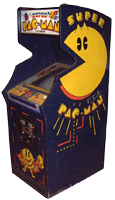
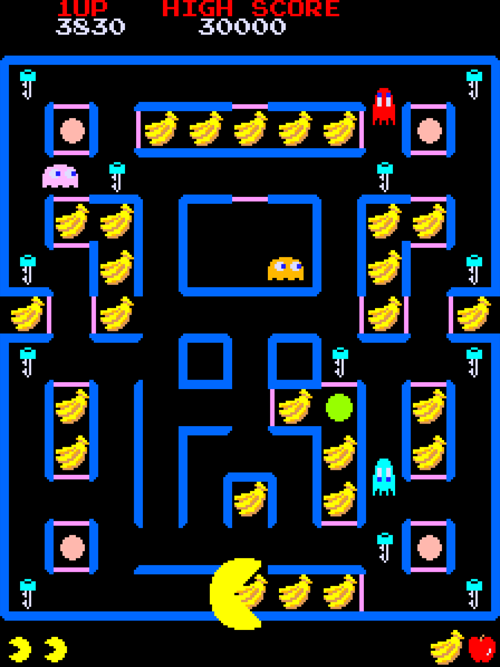
While a lot of folks, especially in North America, think of Ms. Pac-Man as the sequel to Pac-Man, Super Pac-Man is actually the official sequel. Ms. Pac-Man was a Bally Midway game that was developed by General Computer Corporation, and Namco's only involvement was licensing. Super Pac-Man was designed by Toru Iwatani, the designer of the original Pac-Man, and was the official sequel that Namco published. That said, fair or not, Super Pac-Man sits in the shadow of Ms. Pac-Man, one of the greatest video games ever made. As a result, a lot of people today don't even seem to know that this game existed: unlike Pac-Man and Ms. Pac-Man, Super Pac-Man didn't get ported to countless home consoles and computers. Anyway, the concept of this game is similar to the original game, but with a few new twists. In Super Pac-Man, you're still navigating a maze, and still trying to avoid (or eat) ghosts. However, in this game, the pellets are gone. Instead, your goal is to eat all of the food in the maze. You'll notice, though, that there are also keys in the maze and that much of the food is locked behind doors. To get to that food, you'll need to get the keys to unlock the doors. In early stages, the door that a key unlocks may be fairly close to you. In later stages, however, the key you obtain may instead unlock a door on the complete opposite end of the maze. But none of that is super, is it? So how is this game called "Super" Pac-Man, then? Well, that is due to the power pellets. The original power pellets return in this game, allowing Pac-Man to eat the ghosts within the maze. However, you'll also find two larger super pellets, which, when eaten, transform Pac-Man into Super Pac-Man, turning Pac-Man into a giant eating machine. In Super Pac-Man form, you can go through doors and eat the food within, even if you haven't picked up the key to unlock the doors yet. The ghosts also contort themselves in fear until Pac-Man returns to his normal state. Anyway, the addition of the locked doors and the Super Pac-Man form made this game a decent sequel to the original arcade hit, but at the same time, the Super Pac-Man form, and its ability to bypass doors, also felt like it took a lot of strategy out of trying to obtain the proper keys for the proper doors. The end result is a game that Mr. Iwatani himself was critical of, and a game that he found boring. Still, Super Pac-Man is a solid game, and well worth playing if you're a fan of Namco's famous yellow mascot, but it simply isn't the same caliber of game as Pac-Man or Ms. Pac-Man.
Review added: 09/04/2026