
Candory
This game is listed on this website under a different name. To access the review, please click here.
Car Polo
Also known as: N/A
Developer: Exidy
| My Score | Avg. Score | ||||||
| 6.0 | 5.6 | ||||||
| Release Dates | |||||||
|
|||||||
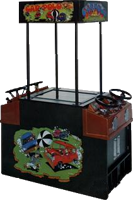


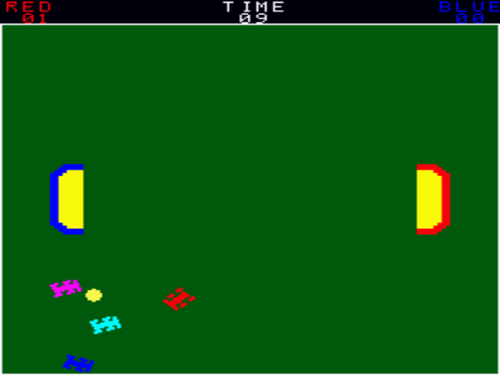
Rocket League took the world by storm a few years ago, with a lot of folks obsessing over the game that saw players take control of vehicles, driving around in an effort to knock a giant soccer ball into their opponent's goal. This hybrid of driving and soccer, while a bit awkward to control at first, won over plenty of folks and became a wildly successful game. However, a lot of folks don't know that Rocket League wasn't the first game to try this. About forty years prior, Exidy put Car Polo in arcades. Car Polo allows you to play with/against up to three other players. Whatever spots are open after the game starts are controlled by the computer. The goal, much like Rocket League, is to use your car to push the giant ball into the opponent's goal. Also much like Rocket League, this isn't exactly a game where you'll start playing and immediately be good at it. The positive, though, is that most other folks won't be good at it either…and by "most other folks," I also mean the computer opponents. Car Polo can be mildly fun when playing with friends as you all try to struggle to score a goal, but against the computer, it's not nearly as fun. Likewise, due to how awkward the game feels, and how difficult it can be to get used to the controls when you play for the first time, it's not uncommon for the time limit to expire with neither side scoring a goal. When you frequently end the game with scoreless ties, the fun fades pretty quickly. Still, though, Rocket League's success four decades later showed that there was some potential in this game concept. Unfortunately, Exidy wasn't successful in making Car Polo anything more than a mildly entertaining distraction to play with friends while you waited for a better arcade cabinet to open up for you to spend your quarters on.
Review added: 11/11/2025
Carnival
Also known as: N/A
Developer: Sega
| My Score | Avg. Score | ||||||
| 7.0 | 7.1 | ||||||
| Release Dates | |||||||
|
|||||||
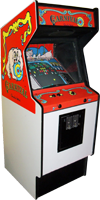
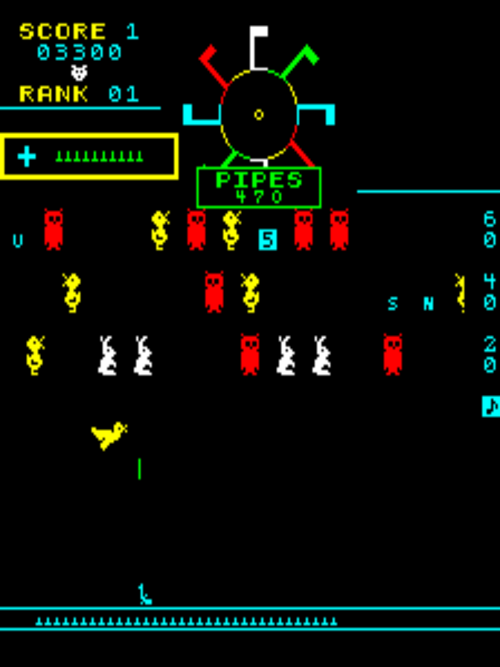
Developed by Gremlin/Sega, Carnival created an alternative shooter for the folks that wanted to experience gameplay similar to Space Invaders but were tired of the non-stop "space invasion" games and wanted a new setting to shoot in. Carnival puts you in the shoes of someone at, well, a carnival. Like the shooting game at a carnival, you've got various targets moving around on the screen. Your goal is to shoot them all down. Rotating within three rows are most of your targets - the benign rabbits and owls, the ducks that love to eat your ammo, and targets that provide you with extra ammunition. There's also a spinning wheel above the rows of targets. The pipes in this wheel can pad your score pretty nicely, so long as you're accurate with your shots - the pipe scores decrease with each shot that doesn't hit one of them. Each round ends when all targets and pipes have been shot. Between rounds, you'll shoot at a bear that paces back and forth over and over, faster and faster, until you're unable to hit it. You may have noticed me mentioning ducks that eat ammunition. No, that wasn't a cute way of saying that you're shooting them, like the term "eat lead" implies. These ducks literally fly down and try to eat your ammunition supply. In Carnival, you only have a limited number of shots that you can fire. You can gain extra by shooting down some extra ammo targets, but accuracy is key to surviving this game - and that includes shooting those dastardly ducks before they gobble up your ammo. Overall, Carnival wasn't too awfully different from a lot of the other shooters available at the time, but the setting was different enough to make it stand out and the gameplay was solid enough to keep players coming back for more.
Review added: 03/01/2026
Cascade
This game is listed on this website under a different name. To access the review, please click here.
Centipede
Also known as: N/A
Developer: Atari

| My Score | Avg. Score | ||||||
| 8.5 | 8.0 | ||||||
| Release Dates | |||||||
|
|||||||

Centipede is like a faster-paced Space Invaders...Except rather than have another shooter taking place in space, Atari went the opposite direction and made a game about pest control in your backyard garden. While the premise doesn't sound as intense as an intergalactic space war, the gameplay is just as intense as any other shooter that you could find in arcades at the time…I’d argue that, despite taking place in a setting that would be considered about as tame as a setting could get, Centipede was actually more intense than most of the shooters set in space that populated every arcade that you'd step foot in. The gameplay also includes some strategy as you try to control the mushroom population that pops up to herd the centipede pieces where you want them to be for easy shooting. It's also worth noting that rather than using a joystick, Centipede used a trackball to move left and right, allowing for more precise movement than you'd find in other shooters of its time. While the trackball may take a little getting used to, once you've got it down, you'll likely be glad that you're using it instead of a joystick. While Centipede doesn't seem to be remembered quite as well or as fondly as some other arcade games of the time, it's still one of the better third-person shooters of its era. As a fella that has had heavy allergies from just about all plant life, and has avoided gardens for the last few decades because of that fact, Centipede showed me how exterminating insects in a leafy garden could be quite a bit of fun...and also quite deadly.
Review added: 04/11/2023
Charley Chuck's Food Fight
This game is listed on this website under a different name. To access the review, please click here.
Checkmate
Also known as: N/A
Developer: Midway
| My Score | Avg. Score | ||||||
| 7.5 | 6.3 | ||||||
| Release Dates | |||||||
|
|||||||
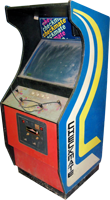
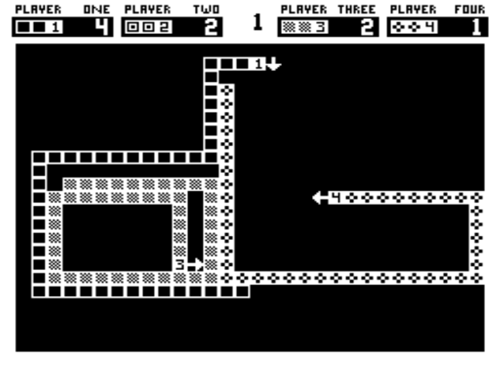
If you see a game named 'Checkmate,' then you're likely going to assume that it's a video game version of chess. This game, however, has absolutely nothing to do with chess. It is a game of strategy, though…even if it doesn't really look like it. Checkmate is a game where four players battle against each other. Each player controls a block, with each block looking unique from the others. When the game begins, these blocks will move in different directions, leaving a trail of their blocks behind. If anyone bumps into any of these blocks, even their own, they are eliminated. The game then continues until only one player is left standing. The strategy of the game comes in trying to both herd your opponents and cover as much of the screen as possible. If you can control most of the screen, even if your opponent(s) manage to avoid you, they'll have a smaller area to move around in than you, so they'll run out of free space before you do. While trying to do this, you've also got to try your best not to find yourself herded into a small area as well. The computer-controlled opponents in Checkmate aren't awful, but they're easily beaten, so the real fun of Checkmate is finding three other friends and matching wits with them. Anyway, Checkmate is a simple but addicting game. It was popular enough that Midway ported it over to their Astrocade home console as one of the built-in games, along with Gunfight. If you're lucky enough to find a Checkmate cabinet still sitting in a pizza parlor somewhere and you've got three friends with you, you'll likely find some fun if you give Checkmate a spin.
Review added: 02/22/2026
Circus
Also known as: Acrobat (Taito), Clowns (Midway), Seesaw Jump (Sega)
Developer: Exidy
| My Score | Avg. Score | ||||||
| 8.0 | 7.0 | ||||||
| Release Dates | |||||||
|
|||||||
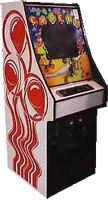
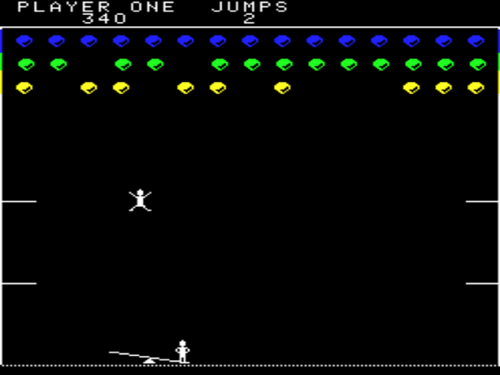
Circus is a different take on the Breakout formula…but with acrobats and a seesaw rather than a ball and a paddle. Basically, there are three rows of colored balloons floating at the top of the screen. Your goal is to pop all of the balloons. How do you do that, you ask? Well, like the game suggests, you're in a circus. So, who else could get high enough to pop those balloons but the circus acrobats? In Circus, you control two acrobats who take turns being propelled to the ceiling via a teeter-totter…or seesaw, whichever term you'd prefer. Your goal is to launch an acrobat into the air, then rush over to make sure that they land on the teeter-totter so that the other acrobat gets launched. The more times that the acrobats get launched, the more velocity they have when going both up and down. So, after a few times of juggling these acrobats, you may struggle to get the seesaw over to their landing point in time, causing the poor acrobat that was in the air to splat on the ground. The concept of the game is simple and easy to understand, and it's fun enough that you'll likely feel the need to pop a few quarters in to play again because you'll just "know" that you can get a better score than you did last time. It's said that Circus is the game that made Exidy the most profit. They even sold the game to other companies to release in their own arcade cabinets : Sega named it Seesaw Jump, Midway named it Clowns, and Taito named it Acrobat, where it was a commercial success for Taito in Japan. Overall, Circus is a solid game and one of the better ones that you can play from the mid-to-late 70s.
Review added: 11/12/2025
Clowns
This game is listed on this website under a different name. To access the review, please click here.
Coccinelle
This game is listed on this website under a different name. To access the review, please click here.
Congo Bongo
Also known as: Tip Top (Europe, Japan)
Developer: Sega

| My Score | Avg. Score | ||||||
| 7.5 | 8.7 | ||||||
| Release Dates | |||||||
|
|||||||

Several years after Congo Bongo was released, Sega created Alex Kidd, and later Sonic the Hedgehog, to battle Nintendo’s beloved plumber. Congo Bongo, however, was Sega’s attempt at taking down Nintendo’s first star, Donkey Kong. Congo Bongo is a bit different in look and design, but the goal and concept are the same as Nintendo’s classic game : avoid obstacles and reach the top where the big ape awaits. The big difference here is that instead of the game being a side-scrolling platformer, like Donkey Kong, Congo Bongo is actually an isometric platformer, giving the illusion of 3D to the player. While the novel concept was unique, and fun once you got the hang of it, that was the catch : you had to get the hang of it. Donkey Kong was a game that anyone could pick up and play. The isometric view of Congo Bongo required some getting used to. The first time you play, you may accidentally send Safari Sam (that's the guy you control in the safari outfit…hence the name) into a river simply because of the isometric view. After a few tries, though, you'll likely get the hang of it. I believe that was partially why, while Congo Bongo was successful, it never reached the popularity of Nintendo’s primate game. A lot of people tend to be impatient , so they'll likely flock towards the game that's easy to pick up and play rather than the one that may take some practice to get the hang of. Still, though, if graphical quality is your preference, then maybe you'll think that getting used to the isometric view isn't such a big deal since Congo Bongo visually looks much more impressive than Donkey Kong does. Anyway, a lot of people still remember Congo Bongo fondly. However, I simply don't see it as being anywhere near the quality of Nintendo's giant ape game. It's a solid platformer for its time, though, and worth checking out if you'd like to see a different take on the Donkey Kong formula.
Review added: 03/11/2020
Cosmic Avenger
Also known as: N/A
Developer: Universal
| My Score | Avg. Score | ||||||
| 6.5 | 6.4 | ||||||
| Release Dates | |||||||
|
|||||||
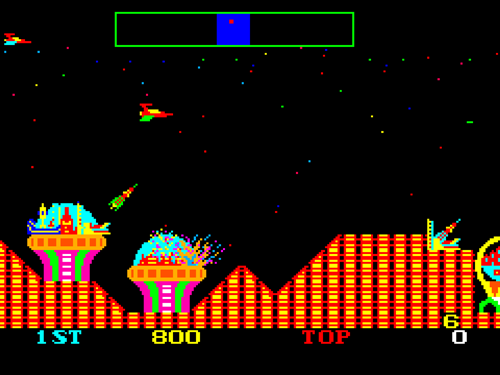
Universal was a known name in arcades back in the early 80s. While I don't think they ever had a mega hit on their hands, they did manage to put a few good games out…though some, like Lady Bug, didn't really get much recognition until they were ported over to home consoles. Cosmic Avenger is one of those weird titles that I can't tell how much recognition it got one way or the other. It sounds like it wasn't a hit in the arcades, but was liked by critics when it was ported over to the Colecovision, where it was one of the launch titles for the console. I'm a little too young to really know how this game was received when it came out, and while critics liked it, that doesn't always translate to the average player liking it as well. The fact that ports were advertised for the Intellivision and Atari 2600, but never released, may hint at either a lack of interest or an inability to bring a side-scrolling shooter to those consoles, which had slightly weaker hardware. Anyway, all of that aside, the arcade version of Cosmic Avenger was Universal's attempt to cash in on the popular new fad in arcade games at the time: the scrolling shooter, popularized by Konami's Scramble and Super Cobra, which appeared in arcades earlier that year. Cosmic Avenger plays somewhat like Konami's duo of games, but with a few differences. First is the fuel system: a gimmick that gave Scramble and Super Cobra some strategy is completely gone here. On one hand, it's nice to focus firepower purely on enemies and not have to worry about topping up your fuel…on the other hand, I somewhat missed the thrill of collecting some fuel just before I was about to run out. Another change is in the speed of the game: while the screen scrolls, you do have control over how fast it scrolls based on your ship's position on the screen. Going forward makes things go faster, while going backward slows it down a bit. While it was a nice idea, I wasn't really a fan of this aspect of the game. Sometimes I didn't want to speed things up or slow them down…I just wanted to maneuver my ship to avoid enemies or their fire. Seeing the screen speed up and slow down so often makes it look a bit spazzy. Cosmic Avenger does, however, take your speed into consideration when you drop bombs, so you can burst forward for a second and drop a bomb to have it drop at an angle…or drop the bomb at a slow speed to have it drop mostly straight down. The bomb explosions also last a while, which can take out enemies if you time them right…but they can also take you out if you're not careful. Overall, Cosmic Avenger is an okay scrolling shooter for its time. It didn't have the impact of other similar games of the time (like Vanguard, which was released the very same month), but it's worth playing if you're a fan of the genre and want to see what some of the early scrolling shooters were like.
Review added: 08/03/2026
Crazy Balloon
Also known as: N/A
Developer: Taito Corporation
| My Score | Avg. Score | ||||||
| 7.5 | 6.9 | ||||||
| Release Dates | |||||||
|
|||||||

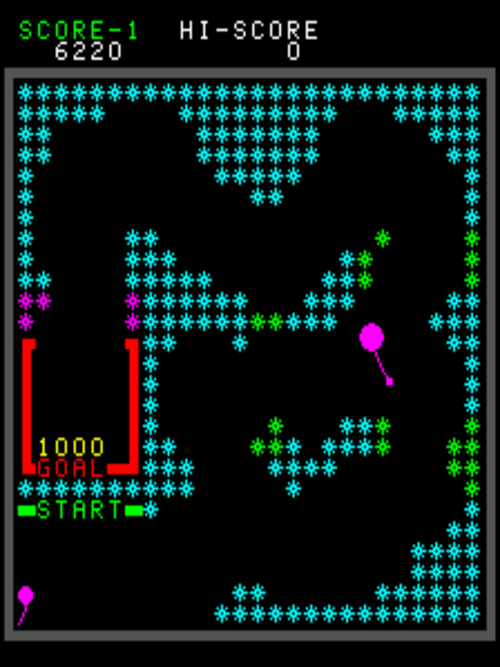
There were games with mazes before Crazy Balloon was released in 1980…but none of them were crazy and/or had balloons. Crazy Balloon has players controlling a box tied to a floating balloon with the goal of getting from point A to point B, in a basic maze, without hitting any spikes along the way. Spikes and balloons don't mix, you know. That task alone may not be difficult, but Crazy Balloon has some twists to make the gameplay challenging. First, the balloon sways back and forth, so if you don't time your movements properly, you'll find the balloon swaying right into some spikes. Next, after you survive the first level, you'll find that some levels that come after don't simply have you trying to maneuver the swaying balloon around a docile maze…the maze begins to fight back with moving spikes, meaning that you don't just have to time your moves carefully, but in some cases, you've got to also time your moves quickly to prevent finding yourself in a situation where your balloon will be popped no matter what. Crazy Balloon isn't a game that I imagine most players will be running towards to play, but if you want to play a solid, simple game that tests your timing and skill, then Crazy Balloon fits the bill there. Taito has included this game in a few of their Taito Legends compilations in the past, and it has also been ported over to modern consoles as part of the "Arcade Archives" series of games. So, if you're curious if Crazy Balloon is a game you'd like, you won't have to track down an arcade cabinet to find out.
Review added: 03/01/2026
Crazy Climber
Also known as: N/A
Developer: Nichibutsu
| My Score | Avg. Score | ||||||
| 8.0 | 7.1 | ||||||
| Release Dates | |||||||
|
|||||||
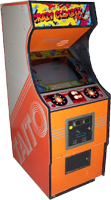
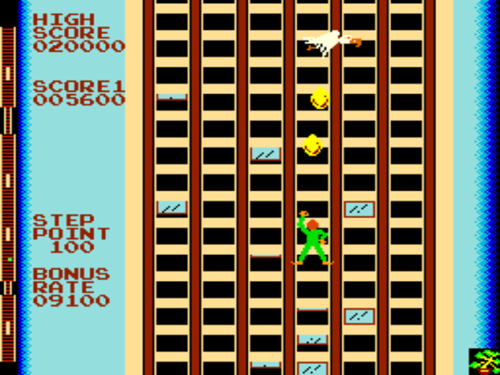
Crazy Climber is one of those "way better to play it at the arcade than on an emulator" games. To me, it's like playing a Dance Dance Revolution or Guitar Hero game with a standard controller instead of with the peripheral designed for it. With Crazy Climber, the gimmick is that the game is controlled via two joysticks that help you emulate climbing. One joystick controls the left side of the character's body, and the other joystick controls the right side. The game starts out easy, where you're simply climbing while trying to avoid windows that open and close…but eventually more hazards appear, making it more difficult and creating more of a panic in the player to move left or right to avoid any obstacle that drops their way. Crazy Climber was a pretty big hit at the arcades, being the third-highest-grossing arcade game in 1980, when it was released, only behind Pac-Man and Galaxian. Even two years later, it was still in the top 10. Because of that popularity, it also found itself ported to a few consoles like the Atari 2600 and Nintendo Famicom. However, despite the popularity of Crazy Climber, it seems to be a game that is largely forgotten about today. I think part of that is that playing the ports of this game at home, or the re-releases in compilations on modern consoles, or even playing the original on an emulator…all of them have you using a standard controller. Part of what made Crazy Climber fun was the unique control scheme. Still, though, if you're lucky enough to find a working arcade cabinet, it's well worth plopping in a few quarters and experiencing this game for yourself. You'll see that folks weren't too crazy to enjoy this climber.
Review added: 11/06/2025
Cutie Q
Also known as: N/A
Developer: Namco
| My Score | Avg. Score | ||||||
| 9.0 | 7.2 | ||||||
| Release Dates | |||||||
|
|||||||
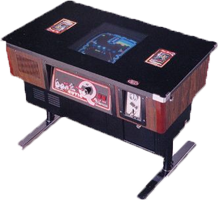
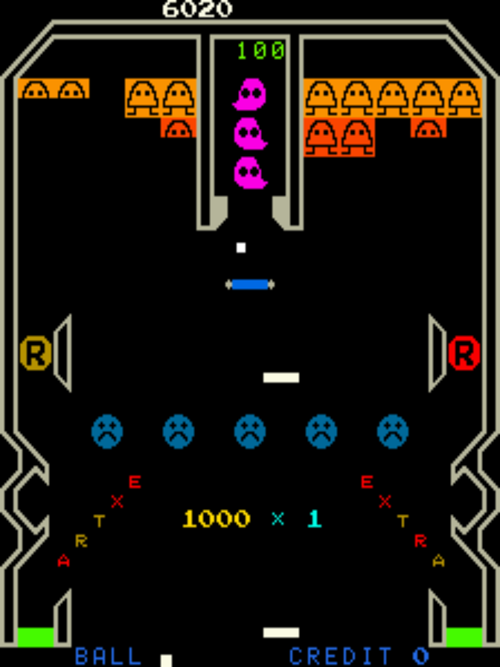
Cutie Q doesn't have the Gee Bee name, but it's actually the third and final game in the Gee Bee trilogy…and they saved the best for last. Cutie Q continues the hybrid gameplay of Breakout and pinball, but adds even more of the pinball elements. Whereas in Gee Bee, some of the bricks seemed very difficult to reach, in Cutie Q, everything seems reasonable to get to. The gameplay is tweaked and improved upon from Gee Bee. Aside from colored blocks to bounce the ball off of, you've also got pink ghosts in the upper center of the screen named "Minimon" to hit. You've also got slow-moving yellow creatures known as "Walkmen" that you can bounce the ball off of for points : the Walkmen appear after you've destroyed all of the colored blocks on one side of the screen or the other. Near the center of the screen, there are smiley and frowny faces. By rolling the ball over those faces, you can make them change expressions. If you make them all happy, you'll obtain a score multiplier. Likewise, if you can light up the letters "EXTRA" on the sides of the screen, you can obtain extra balls. Some people call Cutie Q Namco's first "character game" because of the cute, colorful characters like the Minimon and Walkmen…it's said that this design choice had a major influence on Toru Iwatani's next work, Pac-Man. I really liked Gee Bee, and I thought Bomb Bee was fun, but disappointing. Cutie Q is definitely the best of the bunch, and it ends the Gee Bee trilogy on a very high note. It learned from the previous games in the series and delivered a very, very fun experience. This is a lesser-known title well worth checking out.
Review added: 11/11/2025