
Acrobat
This game is listed on this website under a different name. To access the review, please click here.
Ali Baba and the 40 Thieves
Also known as: N/A
Developer: Sega
| My Score | Avg. Score | ||||||
| 8.0 | 7.0 | ||||||
| Release Dates | |||||||
|
|||||||


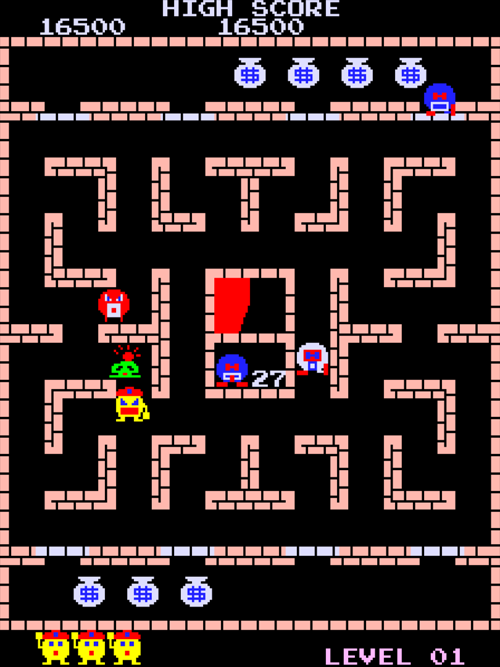
If you're not familiar with the folk story of Ali Baba and the 40 Thieves, here's the gist of it. A poor woodcutter named Ali Baba watched forty thieves open a hidden cave by shouting the words, "Open Sesame!" After the thieves left, Ali Baba entered the cave and takes a small bag of gold to feed his family. I'll skip over the middle part of the story in case anyone wants to read it…but ultimately, the thieves eventually find Ali Baba's house and the leader of the thieves hides his men in 39 oil jars, pretending to be an oil merchant. Ali Baba's slave, Morgiana, discovers the thieves are inside the jars and pours boiling hot oil into each jar, killing them all. Eventually, she takes out the leader, too. Ali Baba, as thanks, gives Morgiana her freedom for saving his life and getting rid of the thieves. I mention the story of Ali Baba and the 40 Thieves because…well, most of it doesn't really apply here. In this game, I believe you control Ali Baba, but rather than hide from the 40 Thieves while Morgiana uses her wits to dispatch them, in this game, you're actually defending the treasures from those thieves. At the bottom of the screen, you'll see seven bags of cash. The goal is to dispatch all forty thieves before they can get away with all of your money. The thieves are clever, though. They don't simply advance down. If you start heading towards them, they may retreat…and then you have the option of trying to chase them down, or ignore them so another thief doesn't sneak in and steal any money. If a thief manages to grab a bag of cash, all is not lost. They still need to exit at the top of the screen. As long as you can catch that thief before they leave, you can save your cash. I really enjoyed my time playing this game, though when I compiled the average score, it looks like a lot of people were either indifferent to it or disliked it. Sega also opted to never release this game outside of Japan, as far as I can tell, and only ported it to the MSX computer (again, only in Japan) so maybe I'm in the minority with my enjoyment of this game. Still, I liked playing Ali Baba and the 40 Thieves and will gladly do so again. I won't hide it. After all, hiding can result in boiling oil being poured on you, so I will gladly praise this game out in the open.
Review added: 08/02/2026
Alien Invasion Part II
This game is listed on this website under a different name. To access the review, please click here.
Alien vs. Predator
Also known as: N/A
Developer: Capcom

| My Score | Avg. Score | ||||||
| 8.0 | 8.3 | ||||||
| Release Dates | |||||||
|
|||||||

Alien vs. Predator is your basic brawler with some nifty little gimmicks tossed in, like the guns that each playable character has. The focus of the game, like most brawlers, is melee attacking your enemies; however, each playable character also has a gun. The guns all pack quite the punch, but if you use them too much, they'll overheat. This forces the player to use their firepower strategically to avoid lengthy cooldown times when they need that firepower most. There's nothing worse than amusing yourself by blowing away a bunch of weak enemies, only to find out that your gun has overheated and now their tough-guy pal has shown up to give you some trouble. While the action itself is mostly pretty basic for a brawler, this element with the guns adds a little something extra to the gameplay, adding just a touch of strategy, making it worth playing for jaded fans of side-scrolling brawlers as well as any fans of either the Alien or Predator movie franchises.
Review added: 01/26/2021
Amazing Maze
Also known as: The Amazing Maze Game (title screen)
Developer: Dave Nutting Associates
| My Score | Avg. Score | ||||||
| 4.5 | 5.1 | ||||||
| Release Dates | |||||||
|
|||||||
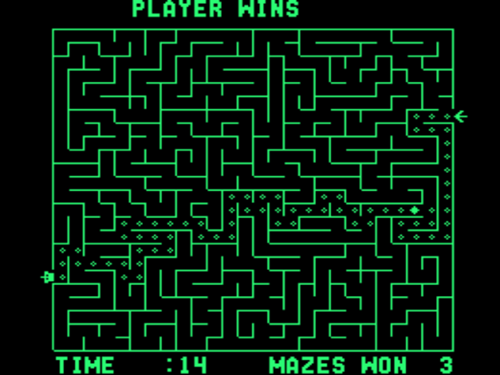
Amazing Maze (or The Amazing Maze Game, if you go by the title screen) looks like it has potential to be mildly fun. You start on one end of the screen, and an opponent starts on the other end of the screen. Your goal is to navigate a maze to get to where they started. Their goal is to navigate the maze to get to where you started. The catch is that there is only one correct path. So, you're basically just racing to make your way through the maze first. This COULD have been fun…but I found that I was completing these mazes in about 20-30 seconds on average. Sometimes, like in the screenshot included with this review, I could get done even faster - the screenshot says 14 seconds. If you're someone that struggles with mazes and thinks that maybe you could find some challenge and enjoyment here…well, probably not. The thing is, if you're playing alone against the computer, it looks like it always takes the correct route. So, if you're not quite sure where to go, you can watch its movements and get the gist of where you should be heading. Playing against a friend makes this mildly more entertaining, but not much. To add to the boredom, it's not too difficult to find yourself getting stuck when trying to turn a corner in the maze…I found myself going forward and backward or up and down a few times in order to unstick myself and move on. When the gameplay is already pretty boring, getting stuck doesn't make anything more exciting. Anyway, even for an early arcade game, Amazing Maze leaves a lot to be desired. Unless you enjoy playing early video games to see how they've evolved, there's not really a reason to play this one.
Review added: 11/01/2025
The Amazing Maze Game
This game is listed on this website under a different name. To access the review, please click here.
American Horseshoes
Also known as: N/A
Developer: Taito

| My Score | Avg. Score | ||||||
| 5.5 | 6.5 | ||||||
| Release Dates | |||||||
|
|||||||

American Horseshoes is, as far as I know, the only stand-alone video game version of horseshoes that you can play. The problem is that it's INCREDIBLY easy once you know what you're doing. It may take a few games, but once you figure out how to throw the horseshoe properly, you'll be getting ringers every single shot... Unless, of course, you want to have fun and interact with the environment by hitting people and objects with intentionally poor throws. In fact, with how easy the game is, interacting with the environment may be the main reason to keep anyone coming back for more. It certainly kept me playing this longer than I had anticipated. Throwing the horseshoe into the environment on purpose can usually result in some comedy. Comedy that’s probably much needed if you’re getting bored from dominating the game. The downside to this aspect is that there are plenty of things to try in order to see how everything interacts with your poor throws... While that would normally be an upside rather than a downside, this is an arcade game. Arcade games require money to be put in to play. That means that in order to experiment and see all of the personality hidden away in this game, you have to either intentionally waste your money by playing poorly or genuinely be bad at this game... And neither scenario is likely to result in the player sticking around for too long. If this was released on a console, where the player didn't have to drop a quarter every time they wanted to see if they could interact with the environment, it would be a huge positive... But in an arcade game, it simply seems like a waste. Anyway, American Horseshoes isn't horrible, mind you, and it can be fun for short spurts, but the lack of difficulty really bogs down what could have been a uniquely enjoyable game.
Review added: 01/26/2021
Armored Car
Also known as: N/A
Developer: Stern Electronics
| My Score | Avg. Score | ||||||
| 6.0 | 6.1 | ||||||
| Release Dates | |||||||
|
|||||||
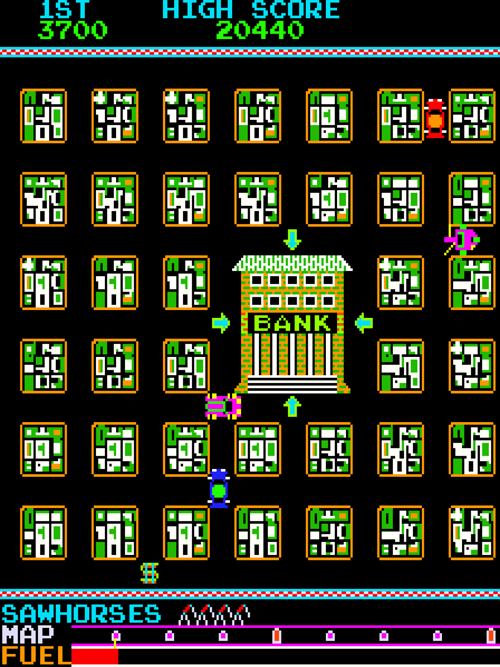
Armored Car is an interesting maze-style game that came out in arcades in 1981. You find yourself driving an armored car, and the goal is to pick up money and deliver it to the bank. Along the way, however, there are robbers doing their best to put an end to your trip…and so is your gas tank, for that matter. If you find your fuel tank hitting empty, you're basically a sitting duck for the robbers to come and clobber you, so finding gas stations, and making a stop to fill your tank, is key to survival and not being on the receiving end of that robber clobber. The streets are also littered with arrows, meaning that if you're being pursued, you can only move in the direction of the arrow when you pass over it. So, if you're not paying attention, you may find yourself pulling away from one robber, and being forced to turn straight into another one. Or, if it's a changing arrow, you could drive into one expecting to go straight, and find yourself needing to turn just at the last second...which can be a bit frustrating. On the other hand, though, if you time it just right, you can also make a smooth getaway from the robbers by passing over an arrow just prior to it changing, with your pursuer being rerouted as you pull away. And you can literally pull away from the vehicles chasing you, too. At the expense of gas, you can press a button to give your car a speed boost, allowing you to both get out of hairy situations and potentially enter new hairy situations if you're not paying close enough attention. As you advance in the game, though, you don't just have robbers to contend with. You'll eventually see steam rollers, street sweepers, and even a TNT truck, which you'll get bonus points from if you're able to get it to crash into a wall when it chases after you. While not exactly a masterpiece of a game, Armored Car is exactly what an arcade game should be: an enjoyable game that you can plop in a quarter to play, and get 5-10 minutes of entertainment out of afterward.
Review added: 04/05/2026
Asteroids
Also known as: N/A
Developer: Atari

| My Score | Avg. Score | ||||||
| 9.0 | 8.0 | ||||||
| Release Dates | |||||||
|
|||||||


When you compare Asteroids to other successful arcade games of the time, it stands out. As good as Space Invaders was, for example, it still wasn't a very frantic game, save for when the speed ramps up after you've played for a while. Asteroids, on the other hand, is pretty much frantic from the moment you shoot your first asteroid. For those living under a rock…or under an asteroid…when you shoot an asteroid in Asteroids, the asteroid shatters into several pieces, with said pieces flying in multiple directions. These asteroids and asteroid pieces all move at varying speeds, and once they enter one edge of the screen, they reappear on the opposite edge, so until you're able to shoot everything and the asteroids no longer split off into smaller pieces, you're always in danger…oh, and there are UFOs that occasionally pop up to shoot at you as well. If all of that wasn't enough, you're in space, so your ship doesn't move like you might hope. The lack of gravity makes your ship continue to float in the direction that you move for a bit, making it even more frantic as you try to maneuver through all of the asteroid shrapnel to avoid being shot by UFOs. For its time, it was a fantastic game, and due to its simplicity, it's still pretty fun to this day if you're able to find a working cabinet.
Review added: 12/27/2022
Astro Blaster
Also known as: N/A
Developer: Sega/Gremlin
| My Score | Avg. Score | ||||||
| 8.0 | 7.5 | ||||||
| Release Dates | |||||||
|
|||||||
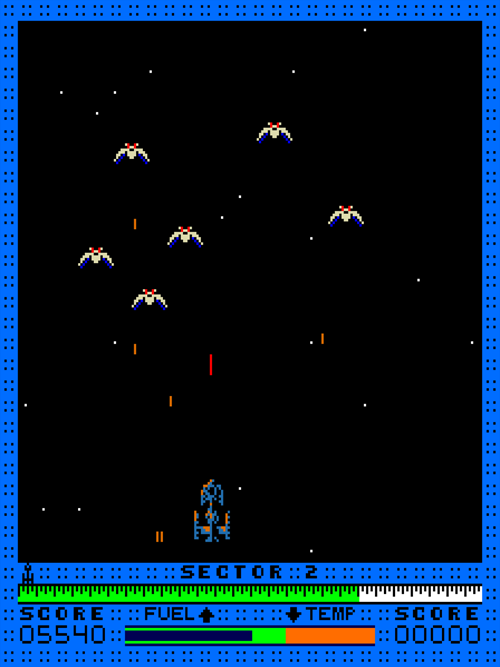
While other Space Invaders-inspired games had come out since 1978, Sega/Gremlin tried their hand at the genre with Astro Blaster, introducing a few new ideas in the process. The first idea, which is immediately noticeable, is the speech synthesis used in the game. Rather than simply hearing bleeps and bloops as you play, this game will "talk" to you. When not in play, the game will try to lure players in with the words, "Fighter pilots needed in sector wars…Play Astro Blaster." With speech synthesis being a bit of a novelty in arcades at the time, I'm sure it got more than a few folks to relinquish some quarters to see what all the hooplah was about. Aside from the speech synthesis, once you begin to play, you'll notice two gauges at the bottom of the screen : one for fuel and one for temperature. The fuel gauge is self-explanatory : your ship needs fuel to function. If you run out of fuel, it's game over. Fuel can be obtained between levels by shooting fireballs. The temperature gauge is a little more interesting, though. If you just blindly shoot, like many shooters of the time allowed you to, then eventually your guns will overheat. If they overheat, then you are unable to fire off any shots until the temperature cools back down. This forces the player to both keep an eye on that gauge at the bottom of the screen and try to time their shots better rather than simply firing off a sea of bullets in hopes that a few hit. There's also a "warp" function that helps with this (though only once per level or life) that slows all enemy spacecraft down, making them easier targets to hit. The gameplay itself is a bit more chaotic than Space Invaders, too, with enemies that move quite a bit faster than in Taito's classic, which makes that warp function a welcome one to help get out of hairy situations. While I wouldn't put Astro Blaster on the same level as games like Galaga, Galaxian, or Phoenix, Astro Blaster is a solid shooter and does enough to make it stand out in a sea of Space Invaders clones of the time.
Review added: 04/05/2026
Astro Smash
This game is listed on this website under a different name. To access the review, please click here.
Atari Football
Also known as: N/A
Developer: Atari
| My Score | Avg. Score | ||||||
| 8.0 | 6.8 | ||||||
| Release Dates | |||||||
|
|||||||
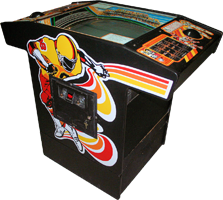
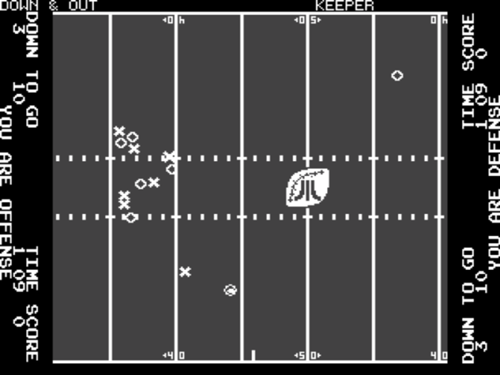
I'm not a football guy. I can honestly say that I've never, ever sat down and watched a full game. I find it boring…and to the people that say that it's a game of strategy, I find watching two people play chess against each other boring, too. That said, I have participated in a handful of football games with friends or in gym class in school, and I don't really mind playing the game….but watching it is a bit of a bore. Since I enjoy participating, I do find fun in some video game adaptations of the sport. Atari Football, released in arcades in 1978, is a pretty impressive game of pigskin for its time. Instead of players, it's X's against O's on the field, like you'd see on those play charts that the football coaches use. Before each play, both teams are required to choose a play to attempt. Plays range from running and passing to punts and field goals….while the play selection is limited, especially by today's standards, it was a perfectly fine number of plays for a game released in the late '70s. Atari Football also popularized the trackball control in arcade games – it's not the first to use it, but it's probably the first wildly successful arcade game to use it. In fact, Atari Football was so popular in the United States that it was the second highest-earning video game in 1979 – the only game above it was the mega-popular Space Invaders. Atari Football was such a well-made game for the sport that, for the next few years, attempts at football by most other developers failed to meet or exceed the quality found here….and when other football games did begin to surpass Atari Football, you could tell that they borrowed much from how this game played. I may not be a big fan of football, but I do like well-made games, and for its time, Atari Football was a very well-made game.
Review added: 01/31/2026
Avalanche
Also known as: Cascade (Europe)
Developer: Atari
| My Score | Avg. Score | ||||||
| 6.0 | 6.5 | ||||||
| Release Dates | |||||||
|
|||||||
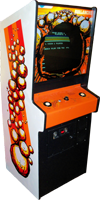
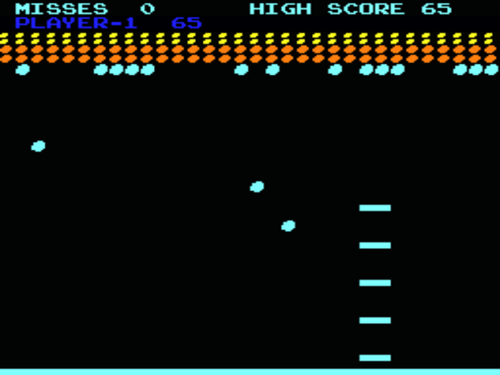
Avalanche is a game that looks an awful lot like a variation of Pong if you just glance at a screenshot, but it's not really anything like Atari's cash cow. Basically, when you start playing Avalanche, you control a stack of six paddles. Rocks will begin to fall from the top of the level, and your goal is to catch the rocks with the paddles. With six paddles, it's very, very easy to catch any falling rocks with only minimal effort. However, once all the rocks in a "heat," as the arcade flyer calls it, are caught, you'll lose one of those paddles. Play long enough and you'll find yourself down to a single paddle and struggling to make sure that all rocks are caught. And, of course, the rocks fall faster the longer you play, and they also get smaller, making everything quite a bit more frantic and chaotic as you go. The only real end goal of the game is to obtain enough points to earn an extra life, which, depending on the number of heats selected, would be 450 or 750 points. The game's arcade flyer also boasts about Avalanche having "realistic sound effects." I've never heard a giant rock from an avalanche make a "boop" noise when landing in something…but perhaps the guy who wrote that flyer lives in a different reality than me….and likely a reality full of drugs. Unfortunately, there isn't much else to the game, really. Avalanche can be a fun distraction to play once…but I can't imagine that too many people were rushing to the arcades in 1978 to play Avalanche over and over and over again. It sounds like it was a mild success at arcades, but it never saw an "official" port to the Atari 2600 until 2025. Instead, Activision took this formula and created Kaboom! a few years later. Still, Avalanche is a decent game to experience at least once…even if only for the amazing "realistic" sound effects that it boasts.
Review added: 01/30/2026