
Galaga
Also known as: Galaga '84 (Bootleg), Nebulous Bee (Bootleg)
Developer: Namco

| My Score | Avg. Score | ||||||
| 10 | 9.5 | ||||||
| Release Dates | |||||||
|
|||||||


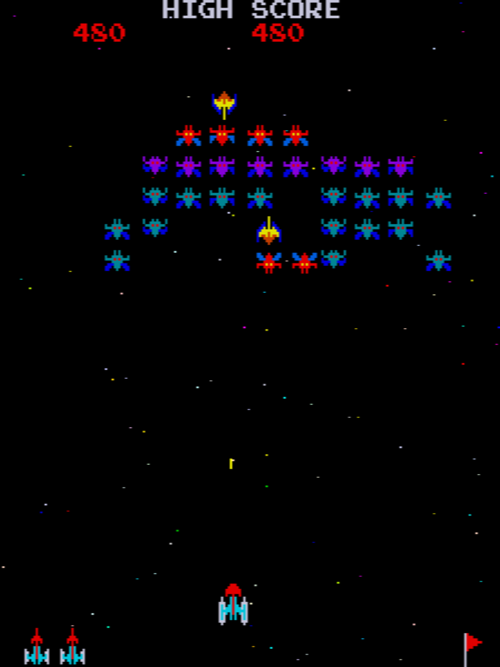
Space Invaders made the concept of moving a ship left and right to fire at enemies moving at the top of the screen popular. Galaxian made an attempt to improve upon that formula, and many would argue that it was successful. With enemies that don't just move left and right and fire at you, but enemies that also swoop down and fly right by you, Galaxian made the "shoot at spaceships at the top of the screen" genre quite a bit more exciting. After Galaxian, Namco released Galaga, which is about as perfect a game as you can get out of that genre...so perfect that since 1981, I don't think another game has come along and knocked Galaga off the throne for that title. Like Galaxian, Galaga includes enemies that break away from the left-and-right movements, with some simply acting as kamikaze pilots, trying to ram their ship into yours. However, the real beauty of Galaga is the ability to power up. Some ships can “steal” one of your ships and hold it hostage. While this costs you a life, if you’re able to destroy the ship holding yours hostage while it swoops down at you, then you'll recapture your ship and get rewarded with double firepower until one of your two ships gets destroyed. If you happen to destroy the ship while the captured ship is in formation, though, then your ship will turn against you. That leaves the player with a choice: should you try to take out the enemies with a single ship, but have an extra life to use if needed? Or sacrifice a life so that you can possibly obtain double the firepower to blow away any enemy that gets in your way? Beyond that, the gameplay and computer logic have all been tweaked to perfection. Galaga is such a fantastic game, and it has stood the test of time wonderfully. It was an absolutely perfect game for its time, and as I write this, nearly four decades later, I don’t think that any other game of its type has come even close to surpassing it in any way. It's pretty obvious why this game is set in space....because Galaga is out of this world.
Review added: 10/19/2019
Galaga '84
This game is listed on this website under a different name. To access the review, please click here.
Galaxian
Also known as: Galaxian Part 4 (Bootleg), Galaxian Part X (Bootleg), Space Invaders Galactica (Bootleg)
Developer: Namco
| My Score | Avg. Score | ||||||
| 9.0 | 8.3 | ||||||
| Release Dates | |||||||
|
|||||||
Namco had been releasing arcade games since 1976…but it wasn't until 1979, when Galaxian was released, that they really got a hit on their hands. Galaxian, at first glance, looks like a simple Space Invaders clone…and Namco developed Galaxian specifically to compete against Space Invaders in the Japanese arcade market. However, once you begin to play Galaxian, you'll see that this is a case where a "clone" surpassed the original game. Like in Space Invaders, you've got a ship at the bottom of the screen, shooting up at enemies at the top of the screen. However, unlike in Space Invaders, where the enemies slowly shimmy their way down towards the bottom of the screen, in Galaxian, ships will start to dive-bomb the player in groups of three. If you're able to shoot down all three of those ships, you'll gain some bonus points. The difficulty of this game is also handled nearly perfectly. Rather than the difficulty suddenly spiking and being overwhelming, Galaxian is designed to gradually increase the difficulty as the player advances. Along with the gameplay improvements, though, Galaxian is also one of the first games to feature RGB color graphics, which further made it stand out. Overall, Galaxian took the concept of Space Invaders, added in some new ideas, and wound up with a superior overall game. Galaxian's sequel, Galaga, took this genre to perfection, but Galaxian was still an excellent game for its time.
Review added: 11/10/2025
Galaxian Part 4
This game is listed on this website under a different name. To access the review, please click here.
Galaxian Part X
This game is listed on this website under a different name. To access the review, please click here.
Galaxy Game
Also known as: N/A
Developer: Computer Recreations
| My Score | Avg. Score | ||||||
| 6.0 | 6.5 | ||||||
| Release Dates | |||||||
|
|||||||
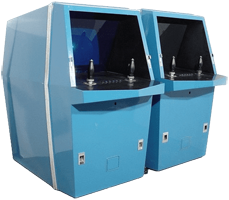
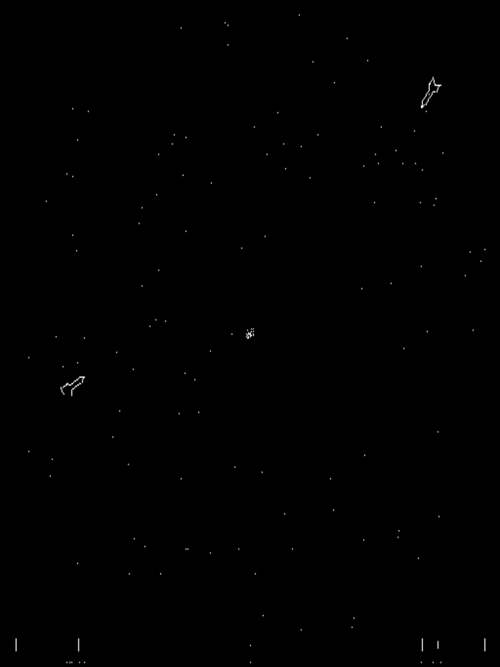
Galaxy Game is the earliest known coin-operated video game. It was installed at Stanford University two months before the release of the first mass-produced video game, Computer Space. Originally, only one unit of this game was built…but later more units and consoles were built so that the game could support two players against each other. As one may expect from one of the earliest video games, the concept for Galaxy Game is pretty simple. Your goal is to fly around and shoot at your opponent while they do the same, shooting at you. Since the game takes place in space, it takes a little while to get your ship moving, and once you do start moving, it takes a bit to redirect your course. If you've played Asteroids before, you've probably got an idea of what I mean. Anyway, because of the space physics, this game usually just breaks down into the loser being hit by a stray bullet more often than by a skilled shot…especially since the bullets tend to blend in with the stars in the background. Galaxy Game is passable for what it is, especially considering how old it is, but even when compared to the very few other games from shortly after this was released, Galaxy Game can feel VERY slow and uneventful. After one or two plays, you'll likely have your fill. Galaxy Game is a historical game, well worth playing so you can see where early arcade games started…Galaxy Game is a great piece of video game history, but it's not likely to be one that will wind up in anyone's top 100 video games of all time list.
Review added: 11/10/2025
Gauntlet
Also known as: N/A
Developer: Atari

| My Score | Avg. Score | ||||||
| 8.5 | 8.0 | ||||||
| Release Dates | |||||||
|
|||||||

If you want a retro game that can stress you out with hordes of enemies flooding the screen to attack you, then look no further than Gauntlet. Likewise, if you want to battle those hordes solo or if you'd like up to three other friends to accompany you in your pain, Gauntlet has you covered. Taking control of one of four different fantasy characters (a warrior, a valkyrie, a wizard, and an elf), your goal is to find keys and eventually the doors to put those keys in, while shooting at (or throwing objects at) any enemies that get in your way. While it sounds like mindless shooting, Gauntlet does actually have some strategy to it. Enemies come from areas that can be destroyed. If you simply shoot at enemies, they'll simply respawn, so sometimes it's necessary (especially in later levels) to make the sacrifice of taking some damage to thin out the horde a bit. You also can't just shoot blindly because the food that can restore your health can also be destroyed by your firepower, so you need to be precise with your shooting if you plan to restore your health without popping more quarters in the arcade machine. While Gauntlet wasn't the greatest game ever made when it was released, it was still very solid for what it was. And despite several sequels, including some in 3D, no other game in the series ever seemed to be quite as addicting as the original.
Review added: 04/11/2023
Gee Bee
Also known as: N/A
Developer: Namco
| My Score | Avg. Score | ||||||
| 8.0 | 6.7 | ||||||
| Release Dates | |||||||
|
|||||||
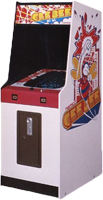
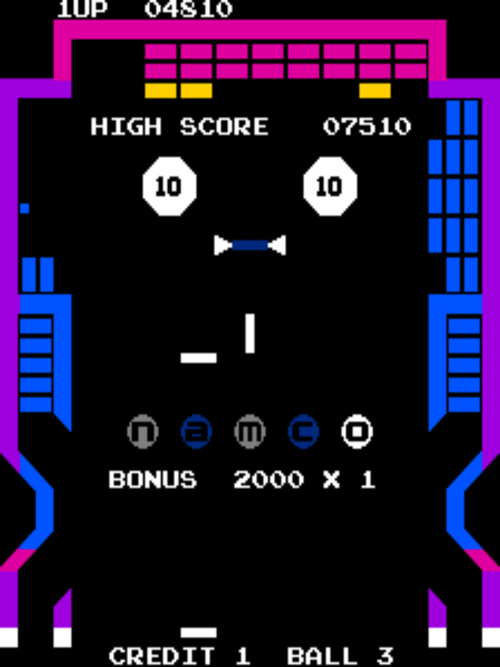
Gee Bee is an interesting game that mixes the block-breaking gameplay of Breakout with the obstacles and occasional chaos of a pinball table. In Gee Bee, your goal is alivin' stay…sorry, that was a reference to the dyslexic Bee Gees cover band, the Gee Bees, and their hit single, "Alivin' Stay." Nobody's buying that one? Well, drat. Let's try this again then: your goal is stayin' alive. You've got three balls per play, similar to a game of pinball. Once you project the ball onto the table, you control two bumpers: one at the top of the screen and one at the bottom of the screen. Using those bumpers, your goal is to not "die" by having your ball leave the bottom of the table, but also to knock out as many bricks as possible. Each time you start a new ball, all bricks reappear where they were and you're back to where you left off. In the center of the screen, you'll also see the word NAMCO. Lighting up those letters all at once can net you bonuses as you play. The catch here, though, is that as the ball stays in play, it gets faster and faster, making the game get more and more chaotic as you go. Oh, and if you're able to light up all letters, you'll gain yourself an extra ball. That's helpful if you're going for a high score. The end result is a much more frantic take on the Breakout formula, and a unique one that's well worth checking out. Games like Pac-Man and Galaxian got Namco most of the attention, but Gee Bee was a solid game put out before either of those games, and it showed that Namco knew what they were doing.
Review added: 11/10/2025
Ghost Muncher
This game is listed on this website under a different name. To access the review, please click here.
Gorf
Also known as: N/A
Developer: Midway
| My Score | Avg. Score | ||||||
| 8.0 | 7.7 | ||||||
| Release Dates | |||||||
|
|||||||

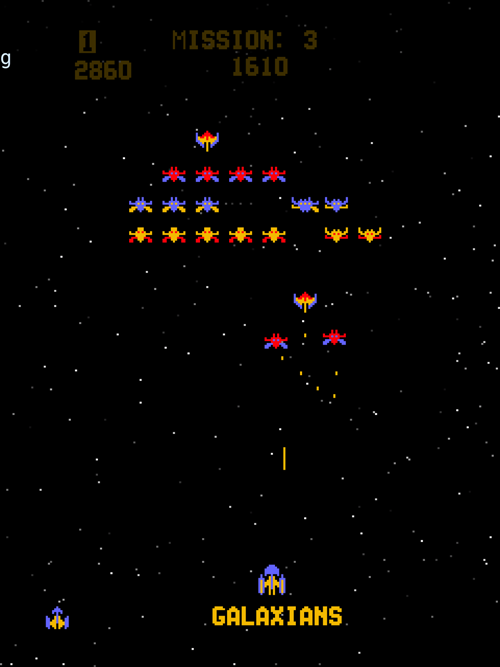
If you were into the Space Invaders craze, and the sea of games inspired by it, then Gorf may have been your dream come true. Split into five different levels, Gorf almost feels like it attempts to show the evolution of the genre, starting out with Space Invaders gameplay, and looking like a simple Space Invaders clone, with the only real difference being that the player is protected by a force field that the enemies must shoot through to get at the player. The next level sees you battling against two formations of five enemies: each formation has a few ships that will leave the formation and dive-bomb you, while one ship fires long laser beams your way. The third level is a clone of Galaxian, with minor changes to prevent it from being exactly the same…the level itself is even called "Galaxians." The next stage shows a warp hole in the center of the stage with enemies flying outward from the center of it and attempting to shoot you down or collide with your ship. The final level puts you against the "flagship" and requires you to blast away a force field, similar to the one protecting you in the first level, before you can begin to chip away at the flagship itself. Once destroyed, the player is rewarded with a nice-for-the-time explosion of the flagship before being sent back to the first level to play everything all over again on a more difficult loop. Later encounters with the flagship include other enemies appearing on the screen as well. The game also used digitized speech to taunt the player during the course of the game. While using digitized speech wasn't new to the arcades, it was still new enough that it was a bit of a novelty and likely convinced more than a few players to part with their quarters to give this game a try. However, whether it was the digitized speech, or the familiar-yet-different, multi-level gameplay, Gorf was a success for Midway. Not just at the arcades, but it was popular enough that it was also ported to various computers and home consoles afterward. If you're a fan of space shooters of the late '70s/early '80s, then it's worth giving Gorf a try: there's a reason it's one of the better-remembered games in the genre to this day.
Review added: 04/07/2026
Got-Ya
This game is listed on this website under a different name. To access the review, please click here.
Grand Champion
Also known as: N/A
Developer: Taito
| My Score | Avg. Score | ||||||
| 5.5 | 6.4 | ||||||
| Release Dates | |||||||
|
|||||||
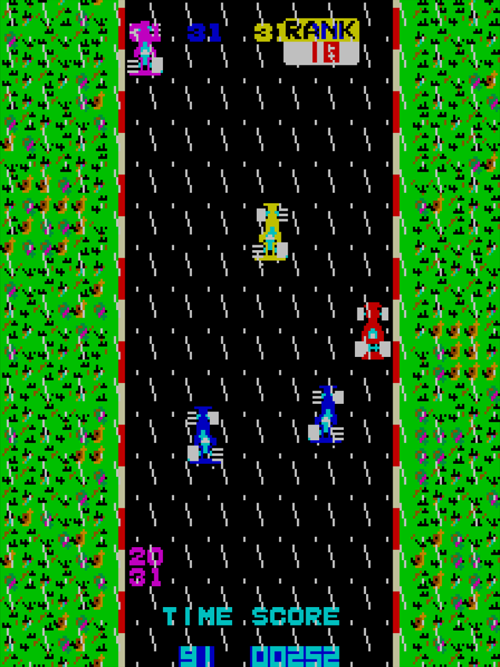
"For real European style racing and a challenging test of driving skill, Grand Champion wins out over the rest!" So says the back of the arcade game flyer. Well, England is in Europe…and to quote my pals over there, Taito made a complete pig's ear of this game. While not completely awful, the only thing that this game is the "grand champion" of is mediocrity. Perhaps Bland Champion could be a better title. Essentially, in Grand Champion, you're in a race against 22 other cars. As the race starts, you'll be in 23rd place, and your goal is to reach number one before the finish line. The race seems to consist of six screens…the first is the "main" driving screen, where you're simply trying to pass all vehicles that you come across. The main screens can have various scenery on the sides of the road, but they all play the same. Then there's the "storm" screen, where you're fighting rain that decreases visibility and makes the road slick, as well as bolts of lightning that shoot down. The next screen is the tunnel, where you have absolutely no vision of anything in front of you, aside from a small area in front of your car that your headlights cover. The next screen has the road divide into two roads, giving you less room to maneuver and safely pass other drivers. The last two screens have the road winding left and right, and then have the road getting wider and narrower…these were the only screens that I really had any issues with: I found that simply positioning my car on the far right edge of the road for most of the race allowed me to pass most cars without the need to do too much maneuvering. These "changing" roads prevent you from using that strategy for the entire race, which is good. Sitting in one spot for the entire race isn't exactly fun. If you crash or get hit too many times, the game will generate a pit stop for you to enter and get your car repaired, which gives any opposing cars the opportunity to either pass you or increase their distance if you hadn't caught up to them yet. The problem with the pit stop is that you aren't invincible for a second or two after pulling back into traffic…and this game seems to spawn rival cars right on top of you immediately after you exit the pits. This doesn't happen constantly, thankfully, but it happens enough that you'll notice it and likely be annoyed. There's also a "radar" on the right side of the screen that allows you to see where all of the rival cars are, both giving you an idea of how close you are to the other vehicles and letting you know how close you are to the finish line. Anyway, Grand Champion is not a very fun racing game. Aside from the fact that you control the game with a steering wheel, there's nothing else that makes this game feel "realistic," as the arcade flyer makes it sound. Taito put out a lot of solid arcade games in the early days of arcades…unfortunately, this one was not one of them.
Review added: 08/08/2026
Gun Fight
Also known as: Western Gun (Europe, Japan)
Developer: Midway
| My Score | Avg. Score | ||||||
| 8.5 | 6.9 | ||||||
| Release Dates | |||||||
|
|||||||
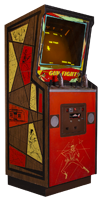
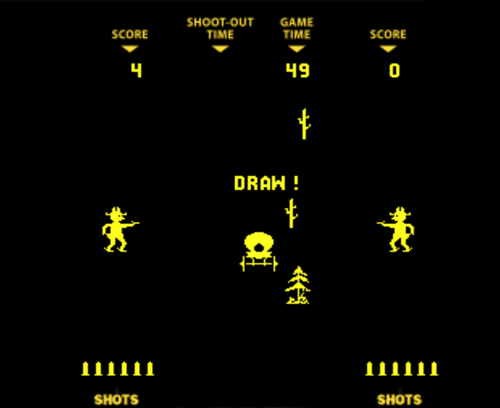
If you can imagine Pong…but with bullets instead of a ping-pong ball, then you've got yourself Gun Fight. In Gun Fight, you'll battle against a friend in a Wild West shoot-out. The goal is to hit your opponent before they hit you. Where's the Pong element, you ask? Your bullets can bounce off of the top and bottom of the screen…so while you can definitely aim and shoot, sometimes you'll have better luck shooting at an angle and/or bouncing a bullet off of the top or bottom of the screen to hit your target. You've also got a limited number of bullets, so you don't want to simply fire them all off willy-nilly or you'll quickly find yourself defenseless while your opponent takes aim at you. You want to be strategic here, while also taking chances with the fancy angled, bounce shots, as I mentioned earlier. When you've got a friend to duel against, Gun Fight can be a blast to play. For a game released in 1975, Gun Fight isn't too shabby. In fact, I'd put it up there with some of the very best early arcade games that I've played. This isn't a game that you'll play for hours and hours with friends, but like most games of the time, it's a very solid way to kill 10–15 minutes with a friend or two, and you'll have fun seeing who the quickest hands in the west are…assuming that this cabinet is in the western part of the arcade that you're visiting.
Review added: 11/11/2025