
Q*Bert
Also known as: N/A
Developer: Parker Bros.
| My Score | Avg. Score | ||||||
| 8.0 | 8.0 | ||||||
| Release Dates | |||||||
|
|||||||



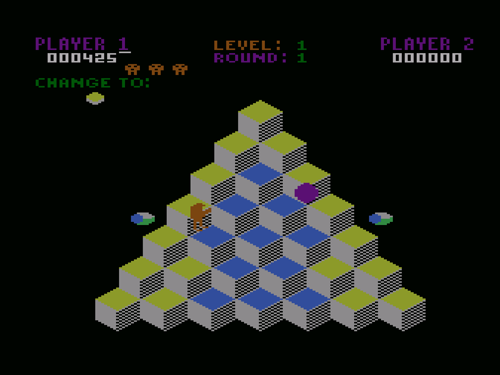
Q*Bert is one of those arcade games that seems to be a pretty safe bet when it comes to ports - I don't think I've played a bad one yet, honestly. Even the severely underpowered Odyssey 2 port, limited due to hardware limitations, was pretty dang good for what it was. So, it shouldn't be much of a surprise that Parker Bros. did a good job with this port as well. The controls in this port take a little to get used to…until you read the manual. Holding the joystick like normal, up is up/right, right is down/right, down is down/left, and left is up/left…which isn't bad, but it does take some getting used to…and you'll likely be sending Q*Bert leaping off into the abyss a bit in the beginning. However, the manual actually suggests turning the joystick so that the four base corners form a diamond. This makes the joystick more like what you'd experience at the arcade, and makes up/left actually up/left, etc. The downside is that even with this "why didn't I think to do that" solution to help with the controls, the home joystick still moves in other directions…and this port can be picky at times if the direction that you move the joystick isn't close enough to what the game wants. When that happens, Q*Bert simply stops moving, waiting for you to try again. This didn't happen to me a lot…but it did happen a few times, so I felt like it needed to be noted here. Graphically, Parker Bros. did a decent job here. It's not the best-looking port, nor does it look exactly like the arcade original, but the look at design works well enough. If you're a fan of Q*Bert and feel like tracking down a copy for your Atari 8-bit computer, you likely won't be disappointed.
Review added: 07/27/2026
Qix
Also known as: N/A
Developer: Atari
| My Score | Avg. Score | ||||||
| 7.0 | 7.2 | ||||||
| Release Dates | |||||||
|
|||||||
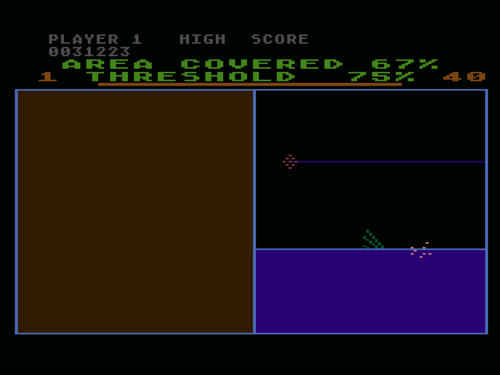
You know - it required me to go back and exclusively play games from the 70s for a few months for me to truly appreciate how good of a game Qix was for its time. Its simple gameplay was easy to understand, addicting, and provided players with nail-biting moments when you risk trying to pull off a giant score and notice that deadly Qix start to make its way to your line as you do so. Despite how simple the game looks and plays, however, somehow Atari managed to botch this game when they brought it to their Atari 8-bit line of computers. This version of Qix isn't unplayable, mind you, it's still okay. But the Atari 5200 version of the game is near arcade perfect…and my understanding is that the Atari 5200 console and Atari 8-bit computers both have very, very similar internal hardware architecture. So, you'd imagine that you could just have one development team handle the job for both port of the game then, right? Well, not if you're Atari. Different teams handled the different ports, and that's why the Atari 5200 version of the game is very, very well done and why this version of the game is lacking in some ways. The big, easily noticeable issue here is that the game takes quite a while to fill in the shapes that you create. In other versions, the color fill happens quickly. In this port, it's like watching ketchup slowly work its way out of a glass bottle. There's also the polarizing feature of drawing lines - on the arcade game, there are two buttons. One for drawing slow lines and one for drawing fast lines. In this version, due to the joystick only having one button, simply moving the line will give you the fast line, and pressing the button on the joystick will give you the slow line. On one hand, I find this to be a nice feature that allows me to play Qix with a single hand, leaving my other hand free to pet a dog, eat soup, or pick my nose. On the other hand, if you're pressing down on the joystick, but at a slight angle, it may also result in you drawing lines when you didn't intend to, which in turn, can result in a marker being lost from a decision that you did not intend to make. So, the control scheme here is up to personal preference - I kind of liked the controls, myself. I didn't have too many issues drawing lines when I didn't want to, and it sure was nice to eat a sandwich while I played. Anyway, this port of Qix is a flawed, but still decent game. However, it may also be the worst port of Qix that I have personally played.
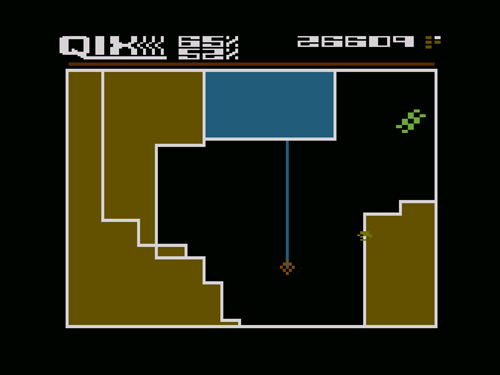 The Atari 5200 variation of Qix is generally believed to be superior to the Atari 8-bit computer version, so, naturally, the Atari 8-bit computer fanbase created a conversion of the Atari 5200 version of Qix that could run on Atari's line of 8-bit computers, which is pictured here. The Atari 5200 version of Qix was a near-perfect port of the arcade game, while the Atari 8-bit version suffered frm some drawbacks - most notably the speed that the screen fills when you successfully create a shape. This Atari 5200 version of the Atari 8-bit Qix is a very solid game that I would bump up to an 8.5 out of 10. From what I can tell, credit for the conversion goes to "Glenn the 5200 Man."
Review added: 07/27/2026