
Maze Game
Also known as: N/A
Developer: Muse Software
| My Score | Avg. Score | ||||||
| 7.0 | 6.3 | ||||||
| Release Dates | |||||||
|
|||||||
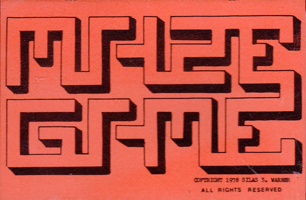


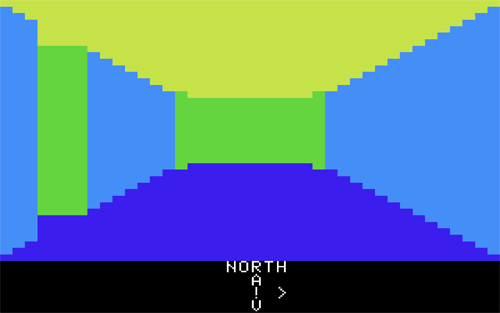
Muse Software put out a very good game in 1978 called Escape. That game had you exploring a 3D maze from a first-person perspective, while talking to various people that you come across while you navigated your way towards the exit. Also released in 1978, by Muse Software, was this game, which I'm assuming came out first. If the giant, sprawling mazes of Escape are a bit too large for you or if you don't want to have to try to determine if strangers in the maze are telling you the truth or not, then Maze Game may be a better choice for you. In Maze Game, you determine how large a maze will be before you begin, so if you don't want to spend an hour trying to find the exit, you can make it a mini maze that you're attempting to escape. Likewise, you can adjust the difficulty of navigating the maze by way of allowing a compass, map, and footprints. By allowing those options, navigating the labyrinth is a breeze. By removing some or all of those options, you can increase the difficulty quite a bit. While Maze Game is impressive for its time, I don't feel like it's the same quality as Escape is. Maze Game provides basic, simplistic gameplay where Escape is a bit more complex and feels a little more polished. Still, if Escape is a bit too much for you and you want a similar game to practice on before tackling one of the giant mazes in that game, then Maze Game is a solid place to practice your navigation skills without any distractions.
Review added: 12/06/2025
Mission: Asteroid
Also known as: Hi-Res Adventure #0: Mission Asteroid
Developer: On-Line Systems
| My Score | Avg. Score | ||||||
| 7.0 | 6.4 | ||||||
| Release Dates | |||||||
|
|||||||
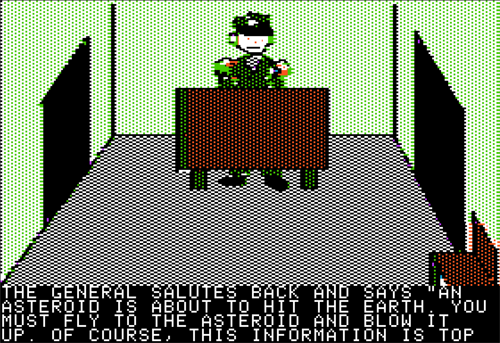
Mission: Asteroid is meant to be an introduction to the Hi-Res Adventure series of games, and it's considered to be number zero in the franchise. Basically, you take the role of an astronaut that has learned that an asteroid is headed towards Earth. Your job is to take a rocket to the asteroid and blow it up before it gets here. To be able to succeed, though, you've got to get through all of the "red tape" at Mission Control…like being told that you stink and need a shower. Once you've showered up and obtain the desired stench, then you've got to board the rocket ship and learn how to fly it before heading out towards the asteroid with some explosives. In terms of the other Hi-Res Adventure games, Mission: Asteroid is probably the shortest one, and possibly the easiest one as well. As an introductory game, it does a decent job of encouraging the player to experiment with the commands found in the manual…and by doing so, they'll figure out ways to advance the story forward. For example, the beginning of the game has you walk into a building (Mission Control) and you're expected to know a password while you hear a bunch of beeping. By using the various commands, you'll eventually figure out what your watch is beeping. By turning the beep off, you'll get a message which happens to also give you the password that you need. Anyway, Mission: Asteroid probably isn't going to be anyone's favorite game or be considered an all-time great classic, but it does what it sets out to do and is entertaining enough while it lasts. If you want to give the Hi-Res Adventure games a try, then Mission: Asteroid is a good start. The lower difficulty, shorter completion time, and design that forces the player to use certain commands will prepare you for how to best tackle the other games in the series.
Review added: 12/14/2025
Morloc's Tower
Also known as: Dunjonquest: Morloc's Tower
Developer: Automated Simulations
| My Score | Avg. Score | ||||||
| 7.0 | 6.9 | ||||||
| Release Dates | |||||||
|
|||||||
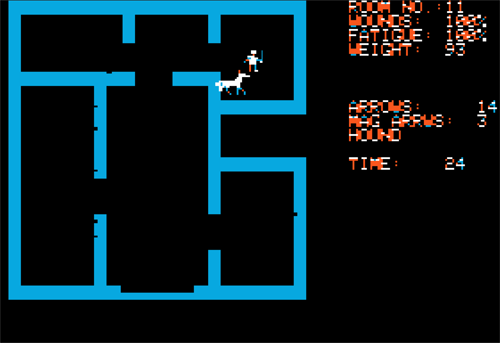
Morloc's Tower is a continuation of the Dunjonquest series, and the second adventure of Brian Hammerhand after the Datestones of Ryn. It's called a "microquest" since it's not quite as deep or large in scale as the Temple of Apshai was. It basically plays the same as the other games in the series do. One of the things that may throw players of, though, unless they've got a manual handy to tell them what to do, even players of some of the previous games may clear out the first floor of the tower, then exit and think that they're done all there is to do. The big thing is that there are invisible stairs located in the bottom right-hand room of each floor. You probably wouldn't know that they're there if it wasn't for the fact that the manual tells you. While in the room, you need to use the up arrow or the A key to go up the stairs. To go down the stairs, you'll press the down arrow or the N key. There are six floors to the tower to explore, so if you plan to see this game through to its conclusion, that's kind of an important thing to know. Also new to the series, but not nearly as difficult to figure out, is that there are closed doors in this game. So, rather than just walk into openings, the game requires you to go up to a door (they kind of look like windows) and press the O key to open the door. There are also secret doors to discover - pressing the E key lets you check for those. The ultimate goal of the game is to find Morloc himself, and eliminate the evil wizard. He's hiding in the tower, so aside from climbing the tower and finding secret doors, you'll also need to search with the S key to find him. Unlike in Brian Hammerhand's previous adventure, though, you're not able to talk to the monsters that you encounter in this tower. So if you come across any creatures, you'll want to fight to survive. Ultimately, Morloc's Tower has some decent ideas in it, and if you like a smaller, shorter RPG, it has you covered. If you dislike the basic gameplay of the previous Dunjonquest games, though, Morloc's Tower won't likely convert you.
Review added: 12/08/2025
Mystery House
Also known as: Hi-Res Adventure #1: Mystery House
Developer: On-Line Systems
| My Score | Avg. Score | ||||||
| 8.0 | 6.6 | ||||||
| Release Dates | |||||||
|
|||||||
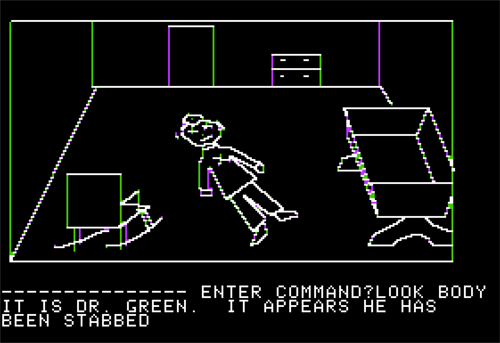
If you've ever thought it would be fun to be locked in a mansion with seven other people…and then find them getting killed off one by one, well, then Mystery House is the game for you, you sicko. The concept of Mystery House is that you are locked inside a mansion, with the task to find a hidden cache of jewels…and after you move one or two screens away from the group, you'll probably stumble across your first dead body. That murderer works quickly. From that point, it's your goal to both determine who the murderer is, and to survive long enough to collect the evidence needed to point the finger at the culprit. Mystery House is considered to be one of the first horror games made…which makes sense, since you're locked inside of a house with a bunch of dead bodies laying around…and potentially, no lights to see your surroundings. Mystery House, like a lot of adventure games at the time, is a text-based adventure game, however, this game also does have some imagery for the player. If there's a dead body on the floor, you'll see the dead body - even if it's cartoonish in appearance. While Mystery House wasn't the first game to do this, it was one of the first and often gets credit for it. The end result, though, is a pretty solid adventure game that's pretty fun to experience at least once. The most impressive thing about Mystery House, though, is that the code for the game was completed in only a few days…with a married couple doing all the work. Roberta Williams wrote the story and made the concept of the game and her husband Ken Williams wrote the code and brought it all to life on the computer. This little side, hobby project for them sold over 80,000 units worldwide, which made it one of the best-selling computer games for its time. Anyway, while a bit crude by today's standards, Mystery House is still a fun little adventure worth playing if you get the chance. There's a reason it was as popular as it was in the early 80s, after all.
Review added: 12/11/2025