
Tictacarith
Also known as: N/A
Developer: Jo Ann Comito
| My Score | Avg. Score | ||||||
| 4.5 | 4.2 | ||||||
| Release Dates | |||||||
|
|||||||


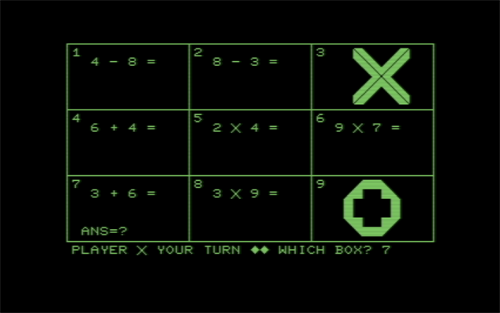
Tictacarith is such an obscure game that I can't really find anything on it, and most websites don't seem to acknowledge that it even exists. So, since that's the case, I figured it'd be a perfect game to review and cover here. It's not great. The end…..Okay, I suppose I can go into more detail. Tictacarith is a game of tic-tac-toe, but with arithmetic questions in each square. In order for you to get your X or O in the square, you've got to solve a math problem. If you fail, then the other player has an opportunity to answer the math problem and if they succeed, then they take the square instead. This does make the tic-tac-toe game less likely to end in a draw, like most tic-tac-toe games wind up being, so that's definitely a positive, and why I've bumped the score up a bit when compared to normal tic-tac-toe games of the time. However, since this is basic arithmetic, if you've got two adults playing this game against each other, there's still a very likely chance that this ends up in a draw, like a typical tic-tac-toe game would. However, for younger players, just starting to learn arithmetic, this could be a pretty fun game where the winner is likely going to be the one that studied instead of partying all night…those dang 2nd graders and their partying. Anyway, Tictacarith is short of being passable, but it's still not an absolutely terrible educational game. However, if you're over the age of 7, I don't know if you'd really find a whole lot of challenge here…unless your goal is to continue to play this game. In that case, you may find motivating yourself to do that to be quite the challenge.
Review added: 12/29/2025
The Temple of Apshai
Also known as: Dunjonquest: The Temple of Apshai
Developer: Automated Simulations
| My Score | Avg. Score | ||||||
| 7.0 | 7.0 | ||||||
| Release Dates | |||||||
|
|||||||

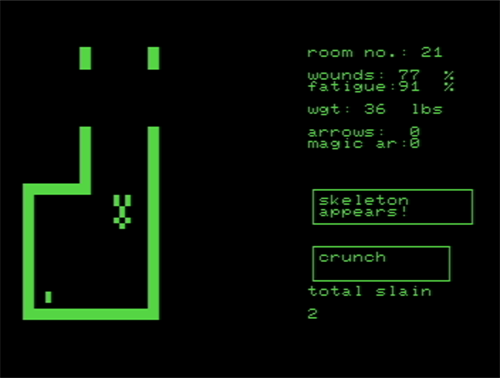
Back in 1979, a company named Automated Simulations started a series of games named Dunjonquest…because they didn't know how to spell dungeon, I guess? Anyway, The Temple of Apshai is the first game in this series. When you begin this game, you need to build a character…or if you don't want to deal with that, you can let the computer generate a character for you. Once your character is generated, you need to purchase equipment and items for your journey. Once all of that is completed, you'll start out in the labyrinth-like dungeon. The dungeon has four different levels and two hundred rooms to explore. As you wander through it all, your goal is to find and collect the treasures that you find. They're located in treasure chests, which basically look like red lines. As you attempt to collect the eighty different treasure types, you'll also randomly come across various enemies like ant men, mosquitos, sewer rats, zombies, skeletons, and ghouls. Unfortunately, in the Commodore PET version of the game, all of the enemies appear exactly the same - four blocks. You only know what type of monster they are based on what the game tells you that you've encountered. The combat (and overall gameplay) is turn-based, so each time you take a turn, the enemies also take a turn. Moving, grabbing treasure, and attacking all count as turns. There are also traps to try to avoid, like daggers, flames, and bottomless pits. While a pretty crude game by today's standards, it can still be a pretty fun experience, albeit, a very slow experience as well. This game does move at a very slow pace, between slow movements and actions and slow loading times as you move from room to room. But, if you had patience, in 1979 you were rewarded with a pretty solid RPG and a good start to the franchise that intentionally spelled the word dungeon incorrectly.
Review added: 03/04/2026
Towers of Hanoi
Also known as: N/A
Developer: A Russel Wills
| My Score | Avg. Score | ||||||
| 7.5 | 7.0 | ||||||
| Release Dates | |||||||
|
|||||||
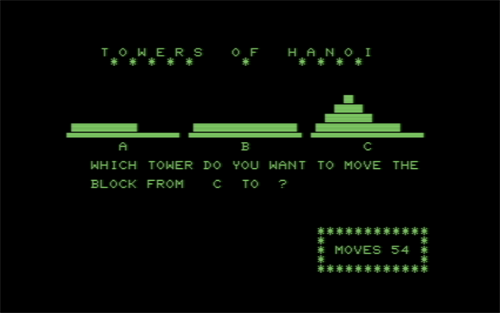
Towers of Hanoi is a logic game…Basically, you've got three sections and a pyramid of blocks in the first section. The other two sections are empty. The goal is to move the pyramid from the first section to either one of the two empty sections. The catch is that you can only move a single block at a time and, to add to the challenge, you can only stack a block on top of another block if it's smaller than the block beneath it. So, you'll be shuffling blocks back and forth as you figure out a way to successfully transfer the pyramid of blocks over to one of the other sections. As you do this, there is a counter on the bottom of the screen that is counting your moves. Moving the blocks isn't necessarily a difficult challenge, even when playing with the largest number of blocks, but it can feel a bit tedious. Aside from feeling tedious, I found myself frustrated with myself when I made a move without thinking and then had to use up two move moves to correct what I had just done. Still, though, it does feel kind of nice when you finish moving the pyramid successfully, and I could see this being a game that I would have played on and off as a child if I had a Commodore PET computer in my home. With this game logging the number of moves that you take, it does motivate you to try again and get a better score…especially when, like I mentioned above, you feel like you wasted a few moves from not fully paying attention. Overall, I think Towers of Hanoi may be a bit too slow and basic for some folks…but with minor options for how many blocks to move, and the turns being logged so you've got a "high score" to try to beat, Towers of Hanoi is still a decent logic-based puzzle game if you've got a Commodore PET to play it.eas
Review added: 12/29/2025