
Take the Money and Run!
Also known as: Pegue o Dinheiro e Corra! (South America), Prendre l'Argent et Fuir (Europe), Prenez L'Argent et Filez! (Europe)
Developer: Magnavox
| My Score | Avg. Score | ||||||
| 8.5 | 6.7 | ||||||
| Release Dates | |||||||
|
|||||||
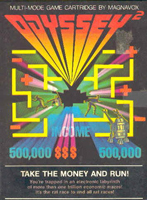


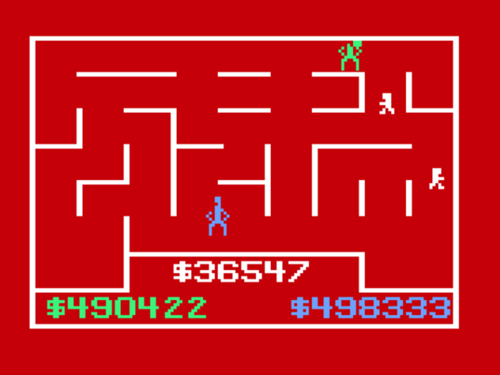
Take the Money and Run! seems to be one of the early home console games that's the victim of it not really being clear what to do, unless you've read the manual beforehand. Ambitious games like this one are often seen as being awful simply because the player didn't understand how to play it beforehand. Basically, Take the Money and Run! Is a two-player game where each player starts with $500,000 a piece, and they each control a human. The screen shows a maze and two robots, that kinda look like smaller humans. The goal is to continue to add to your sum of cash and to not lose money…but how you achieve that goal is different on each level. In some levels, you want to work with the other player to outwit the robots. Other times, you'll want to work with the robots to outwit the other player. At the start of each stage, you'll see a message pop up telling you what kind of stage it is and how much money is at stake for that round. You can also tell what to expect from the round by looking at the robots. If the robots are brighter in color, they're shy little guys. Your goal is to catch them as quickly as possible so that you can add to your pile of cash. The darker robots, on the other hand will try to catch you. When they catch you, you lose money, so the longer you can avoid them, the more money that you'll keep. If you find a very good hiding spot, or happen to use the other player as a shield, it is possible to completely avoid those little rust buckets until the round is over. It should be noted that since the humans are all larger than the robots, that they need to "duck" to fit into certain parts of the maze. As odd of a design choice as it seems, it actually adds to the gameplay, especially since ducking at just the right time can be the difference between catching a robot and/or not being caught by a robot. The mazes themselves are all different, too. The manual claims that there are over a trillion different maze combinations in this cartridge. However, there are seven main maze types in total, each with a financial theme and they'll be noted at the start of each round. Income, reward, and investment are all mazes where you want to catch the robots and make some money. Expenses, thief, taxes, and inflation are all stages where you want to avoid the robots at all costs so that you don't lose any money. Beyond simply catching and avoiding robots, since this is a player vs. player game, Magnavox also included the ability to harass your opponent. If you've managed to already make contact with a robot on a stage, if you're able to make your way over to your opponent and can touch them and part of the maze at the same time, then your opponent will lose control of their person on the screen for that round. Likewise, if you work together with the other player, and are able to manipulate the two robots into running into each other, the robots will respawn at their starting points and both you and your opponent will gain time and money as a reward. The first player to have a net worth of over one million dollars is the winner. Despite the weird theme and name, Take the Money and Run! is a very solid two-player experience and well worth checking out if you've got an Odyssey2.
Review added: 12/04/2025
Ten Pin Bowling / Basketball
This game is listed on this website under a different name. To access the review, please click here.
Terrahawks
This game is listed on this website under a different name. To access the review, please click here.
Thunderball!
Also known as: Fliperama! (South America), Flipper (Europe), Flipper Game (Europe), Machine À Boules! (Canada)
Developer: Magnavox
| My Score | Avg. Score | ||||||
| 5.0 | 4.9 | ||||||
| Release Dates | |||||||
|
|||||||
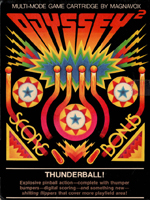
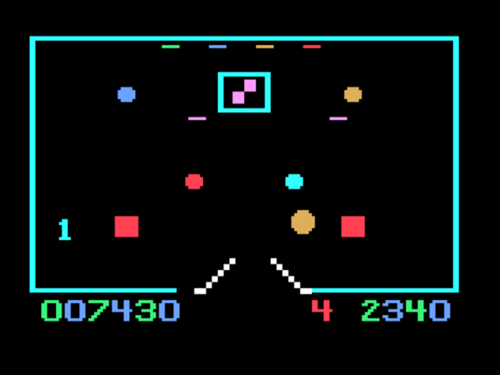
Think of Thunderball! as a pinball game, but with the ability to move the paddles slightly left and slightly right to, in theory, eliminate the "dead" area where the paddles can't reach in the middle. I'm a little torn on the gameplay of Thunderball! On one hand, it technically does what it sets out to do - emulate a pinball table where you may spend time simply watching the giant, orange pinball bouncing around and racking up points for you without doing anything. In fact, I spent over a minute straight of not doing anything except holding the action button down to keep the paddles up. Every time the ball hit the paddles, it shot back up like I had activated the button and the paddles had swung up again instead of like it was hitting a stationary object. Me holding the paddles up is a tactic I sometimes use to help line-up a shot…but here, it just acts like an auto-fire option. Anyway, hitting most of the bumpers on the screen will get you bonus points, which can be seen on the lower right hand of the screen. After you're able to accumulate more than 5000 points, it gets added to your main score on the lower left side of the screen and the bonus points reset back to zero, and some of the bonus bumpers that had disappeared from the screen reappear. The player has five balls to rack up as high of a score as possible. When reviewing some of the older games like this, I like to remind myself of how other games were at the time, and the limitations of the hardware that the games were on. In the case of Thunderball!, I recently was reading an old video game magazine from 1983, and even back then, it seems like Thunderball! wasn't exactly setting the world on fire. It was given a 4 out of 10 in the Electronic Games 1983 Software Encyclopedia. Ultimately, I consider Thunderball! to be slightly better than that, but if given the choice between this game and a real pinball table, I'll always take the real table.
Review added: 12/04/2025