
Backgammon
Also known as: N/A
Developer: APF Electronics
| My Score | Avg. Score | ||||||
| 5.5 | 5.3 | ||||||
| Release Dates | |||||||
|
|||||||


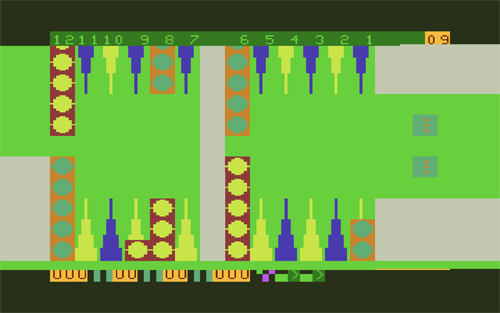
Prior to playing the APF Microcomputer version of Backgammon, I had never played a game of Backgammon in my entire life. But, while looking at early home video games, I kept seeing Backgammon pop up. If I was going to play every game for some of the more obscure consoles, I was going to have to teach myself how to play this game. So, for those of you who have never played it before, here's the gist of it. Backgammon veterans, bear with me if I've gotten anything wrong. Basically, you've got a board with twenty-four points on it. Each player places five checkers on the six point area, three checkers on the eight point area, five checkers on the thirteen point area, and two checkers on the twenty-four point area. Then you start rolling a pair of dice. The numbers that pop up on the dice represent two separate, potential moves. For example, if you roll a three and a five, you can either move one checker three spaces and one checker five spaces or you can move one checker eight spaces. Ultimately, the goal is to get all of your checkers removed from the board to win the game. Yes, I glazed over some of the rules, but that's the basic concept. Anyway, this version of Backgammon has two variations - one where you play against a friend, and the other has you battling against a computer opponent. The computer battle has a very, very odd gameplay decision that requires YOU to roll the dice for the computer. I can't imagine that having the computer roll its own dice would be too difficult to program into the game, but for whatever reason, it was left out. It should also be mentioned that the game can only display five checkers in any given location at once - if there are more than five in a location, they're still there, but they're stored in the system's memory and not displayed on screen. Anyway, due to its limitations, this isn't a great way to play Backgammon. While it's not an awful mess of a game, it's still short of being passable. If you're a Backgammon nut, then you may be able to overlook some of the flaws here…but for beginners, like me, this isn't a great video game translation of the game.
Review added: 12/20/2025
Baseball
Also known as: N/A
Developer: APF Electronics
| My Score | Avg. Score | ||||||
| 7.0 | 6.4 | ||||||
| Release Dates | |||||||
|
|||||||
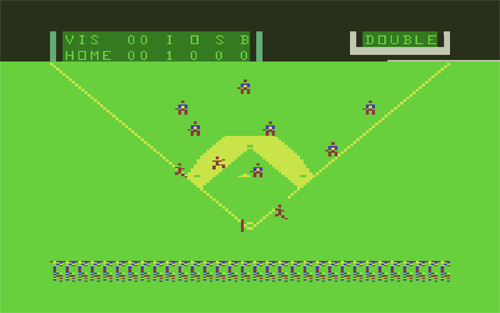
Baseball is the first decent game that I've played on the APF Microcomputer System….granted this is also only the third game that I've played as I typed this, but the first two fell way below what I consider to be a passable game, so Baseball was a breath of fresh air…even if it largely feels like other baseball games of the time. I will say, however, that while the game does look and play very similarly to other video game adaptations of the sports from the time, I did enjoy that the fielders will sometimes leap in front of the ball for a diving catch. You can also control the curve and speed of the ball when you're pitching - not all game of the time allowed the ability to control both. You can also position your outfielders while pitching…so if it looks like your opponent is consistently hitting the ball in a certain area of the field, you can try to position your outfielders in that area in hopes of getting an out. It's kind of hard for me to write a whole lot more about this game, though, since aside from the things I mentioned above, it's largely the same baseball game that you can see anywhere else at the time. Still, Baseball is a decent game and, from what I've seen so far, may be one of the only games worth playing on the APF Microcomputer System.
Review added: 12/19/2025
Blackjack
Also known as: N/A
Developer: APF Electronics
| My Score | Avg. Score | ||||||
| 7.0 | 6.4 | ||||||
| Release Dates | |||||||
|
|||||||
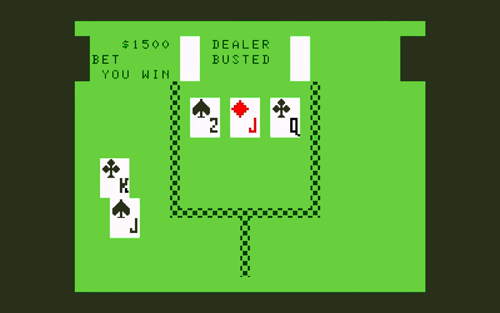
Baseball is the first decent game that I've played on the APF Microcomputer System….granted this is also only the third game that I've played as I typed this, but the first two fell way below what I consider to be a passable game, so Baseball was a breath of fresh air…even if it largely feels like other baseball games of the time. I will say, however, that while the game does look and play very similarly to other video game adaptations of the sports from the time, I did enjoy that the fielders will sometimes leap in front of the ball for a diving catch. You can also control the curve and speed of the ball when you're pitching - not all game of the time allowed the ability to control both. You can also position your outfielders while pitching…so if it looks like your opponent is consistently hitting the ball in a certain area of the field, you can try to position your outfielders in that area in hopes of getting an out. It's kind of hard for me to write a whole lot more about this game, though, since aside from the things I mentioned above, it's largely the same baseball game that you can see anywhere else at the time. Still, Baseball is a decent game and, from what I've seen so far, may be one of the only games worth playing on the APF Microcomputer System.
Review added: 12/20/2025
Bowling / Micro Match
Also known as: N/A
Developer: APF Electronics
| My Score | Avg. Score | ||||||
| 4.0 | 4.8 | ||||||
| Release Dates | |||||||
|
|||||||
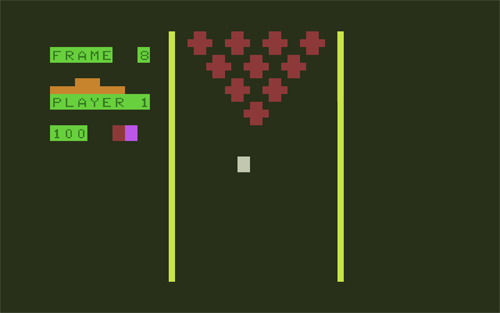
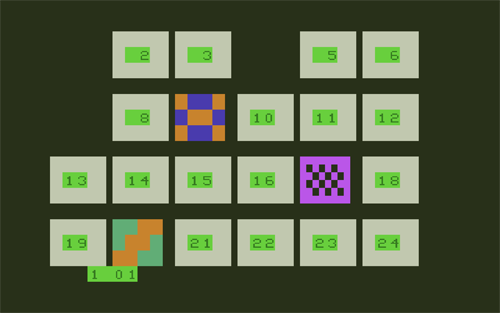
Well this is an odd pairing to put together on a cartridge…but at least both games aren't absolutely terrible. Neither one is good, mind you, but neither one is terrible, either. We'll start with Micro Matchup, labeled as Micro Match on the box. The first five game options on this cartridge are variations of this game. All of these game variations can be played by one to four players. This is your typical matching game…you pick a number to reveal what is behind that box. Then you try to pick another number with the same item behind that box. The first two variations are this typical formula. The other three variations are slightly more interesting. Instead of having to match two of the same word or object, you have to match three of the same word or object. While it's only a mild change, it does make the matching game a little more interesting than it normally would be. The last three game options are all for Bowling. In this variation of bowling, a cursor moves back and forth on the bottom of the screen. Pressing the button releases the ball and sends it towards the pins. It's a very basic game of bowling, however I will admit that at least the pins "react" as they should. I put react in quotes because while you can pick up splits in this game, there is no animation of the pin swinging over to knock down the other pin. If you hit a pin on one side in the right spot, the game just wipes out that pin and the pin(s) you were trying to knock down for the spare. It does seem a bit forgiving, though. I only had one open frame in my first game…and most frames were strikes. Another downside is that while there are three Bowling game modes, the only difference between them is the speed in which the cursor moves back and forth. A positive, though, if that like Micro Matchup, all three variations can be played by one to four players. I've played much worse combo cartridges than this one, but I see both games as being just shy of passable. The lack of difficulty makes it difficult to want to keep coming back to anything here….however, these may be decent games for very young children, specifically the Micro Matchup games. So, if you've got an APF Microcomputer System, and a wee little child, this may be a good game to keep them occupied for a while.
Micro Matchup
Bowling
Review added: 12/19/2025
Boxing
Also known as: N/A
Developer: APF Electronics
| My Score | Avg. Score | ||||||
| 4.5 | 4.8 | ||||||
| Release Dates | |||||||
|
|||||||
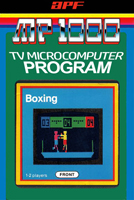
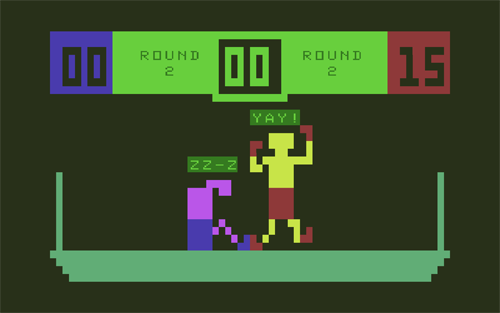
Have you ever wondered what it would be like to participate in a boxing match where both combatants throw some of the most awkward-looking "punches" in the history of the sport? It basically looks like the boxers are both students of Dhalsim from Street Fighter II, with the ability to stretch out their limbs…but while also dislocating their joints as they punch. Anyway, Boxing has no real strategy that I could see. If feels more like a game of Rock 'Em, Sock 'Em Robots than the "sweet science" of smashing a padded fist into someone's face. Essentially, you've got six different ways to play this video game adaption of the sport - three of them are single player and three of them are two-player games. The three two-player games are basically the exact same game, but with different rules, they're games 1, 3, and 5 on the selection screen. Boxing is a 15 round fight against a friend, 5 Round Bout is a 5 round fight against a friend, and Sparring is a fight against the friend with no knockouts - the winner is the player with the most points at the end. The single-player modes are games 2, 4, and 6 on the selection screen. Boxing with Horrible Harry is a 15 round fight against the computer, Jabbing Joe is a 5 round fight against the computer, and Spar with Slugger Sam is another fight with no knockouts and the player with the most points at the end is the winner. The first four games all have 60 second rounds. The last two, the sparring games, only have a single round, but they're 99 seconds instead of 60. When fighting, the way to obtain a knockout is to hit your opponent five times in a row without them successfully hitting you. Otherwise, the player with the most offense gets points at the end of the round. There is blocking here, too, for those wondering…but since points at the end of the round are based off of the person on the most offense, you don't really want to rely on it. Anyway, for its time, the graphics are impressive, with the boxers taking up much of the screen…but this just isn't a very fun game to play. You may have mild amusement with a friend playing this one time, but I doubt that most folks will be back for round two.
Review added: 12/21/2025
Brickdown / Shooting Gallery
Also known as: N/A
Developer: APF Electronics
| My Score | Avg. Score | ||||||
| 5.0 | 5.3 | ||||||
| Release Dates | |||||||
|
|||||||
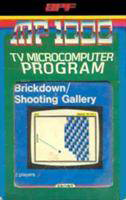
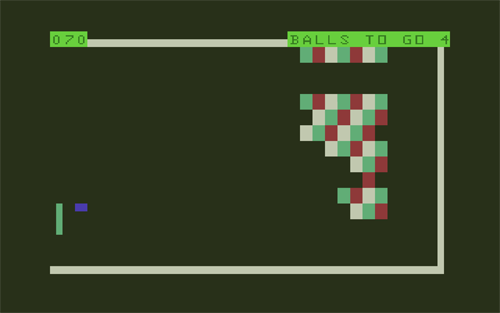
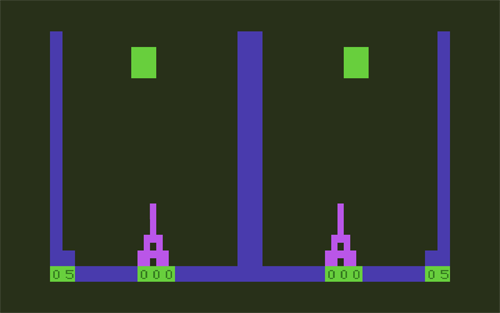
My score of Brickdown / Shooting Gallery is bogged down a tad - it's a decent game bundled with a poor game, and the average of the two scores is why the score of this bundle is as low as it is. I'll start with the good game and its variations. Brickdown is basically Breakout, but sideways instead of vertical. Unlike the Apple II variation of this game, Little Brick Out, which looks very similar to this one, I feel like everything controls well. Also, the pesky little aspect of the paddle always being "just shy" of hitting the ball is not present in this game. Yes, I had a few instances of just barely missing the ball, but it wasn't constant and it felt like it was my fault when I missed, where in Little Brick Out, it felt like I was in the correct spot and the game decided to slightly alter its angle at the last moment. There are also four different ways to play Brickdown - two games with eight layers and two games with twelve layers. Anyway, Brickdown isn't quite as fun as Atari's arcade or Atari 2600 variations of the game, but it's still one of the better games that you'll find on the MP-1000. The last three game variations on this cartridge are called "Shooting Match." Yes, the box and the sticker on the cartridge say "Shooting Gallery." This game is pretty dull. Basically, you've got a target at the top of the screen. The goal is to hit the target with the least number of bullets. As you hit the target, the size, color, and speed of the target may change. After hitting all five targets, the game is over. If you're playing a two player game, that means that one player has to sit and wait for the other player to finish before they see who is the winner of the match. Honestly, sitting and waiting is probably the most exciting aspect of the game since it means that you don't have to actually be playing it. Overall, if you're looking for a decent game for the APF MP-1000, then Brickdown can fit that bill, but I doubt that you'll be spending too much time with the Shooting Gallery half of the cartridge.
Brickdown
Shooting Match
Review added: 12/19/2025
Casino 1: Roulette / Keno / Slots
Also known as: N/A
Developer: APF Electronics
| My Score | Avg. Score | ||||||
| 2.0 | 3.4 | ||||||
| Release Dates | |||||||
|
|||||||
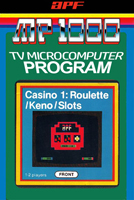
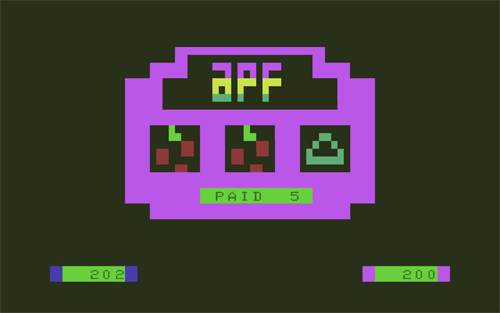
The only thing that makes Casino 1 fun is if you wear a suit and sunglasses, then have someone else play the game while you stand nearby with your arms crossed. When they lose all their money, then grab them by the back of their pants and the back of their shirt and throw them out the front door of your house…what? That's how it's done when you lose it all at the casino…the dang gambling addict friend of yours will thank you for the tough love that you're showing them…..just make sure to gently remove their wallet before kicking them out of your house. It's for their own good that you use their money for more important things…like calling Miss Cleo to figure out what the lottery numbers will be next week. Anyway, I suppose I should probably talk about this game now…probably. Casino 1 is three games in one - roulette, keno, and slots. Roulette is a pretty dull game of guessing, especially since you can't see the wheel. I've never seen the point of playing roulette in a real casino, where there's a chance to win money so it's hard for me to understand the appeal of playing it when nothing is at stake. Next is keno. The computer will pick 20 numbers out of 80…and you pick between 2 and 15 numbers. The number of picks that you make determines the payoff that you get. It basically feels like a variation of roulette, but with potentially better odds of winning. The last game, is slots…and if you've read some of my reviews of other slot machine video games, you'll know that I loathe them. This variation is no exception. Not only is the slot machine painfully slow to play, but it's not even interesting to look at. It's one of the worst slot machine games that I've played…which says a lot. The end result is a trio of awful casino games that I doubt many folks would enjoy. In fact, if they were to gamble on whether this game was good or not, they'd probably go bust. On the plus side, then you can grab them by the shirt and pants, like I mentioned at the start, and toss them from the house…and toss this cartridge out the door with them.
Review added: 12/20/2025
Catena
Also known as: N/A
Developer: APF Electronics
| My Score | Avg. Score | ||||||
| 7.0 | 6.7 | ||||||
| Release Dates | |||||||
|
|||||||
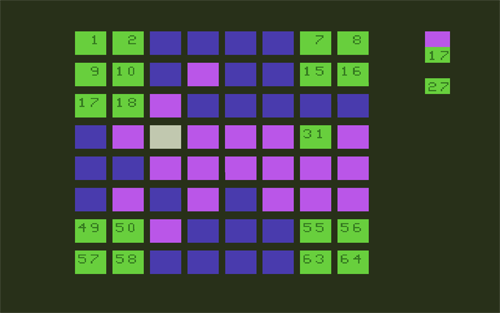
I don't know if I still fully understand Catena, but from what I can tell, it seems to basically be a video game version of Othello. The goal is to take turns, either playing with a friend, or against the computer, and fill the board up with colors. Once the board is filled, the player with the most squares as their color on the board wins. If you don't feel like the instruction manual is very clear on what to do (none of the manuals for the APF MP-1000 games are) then this game has the unique game mode where you can watch the computer compete against itself. By watching the computer, you can get a feel for how the game works and what you need to do when you start giving it a try on your own. Watching the computer battle itself is also a nice way to learn some tactics and moves to try if a similar situation pops up when you play…and likewise, gives you an idea of what situations you want to avoid. Catena is the kind of game that is fairly easy to learn how to play, but it likely takes some time to really master. The simplistic, yet complex strategy here helps create one of the better games for the MP-1000 that's a decent game to play whether you're playing solo or with a friend. If you ever find yourself owning an APF Microcomputer, Catena is one of the games that you should add to your library.
Review added: 12/18/2025
Hangman / Tic-Tac-Toe / Doodle
Also known as: N/A
Developer: APF Electronics
| My Score | Avg. Score | ||||||
| 3.0 | 4.1 | ||||||
| Release Dates | |||||||
|
|||||||
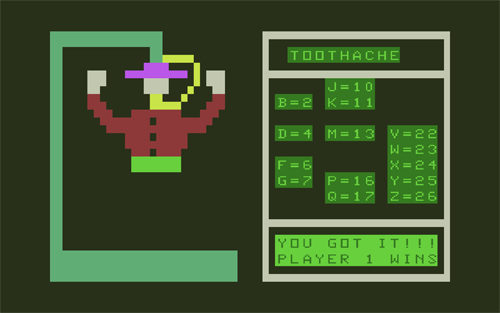
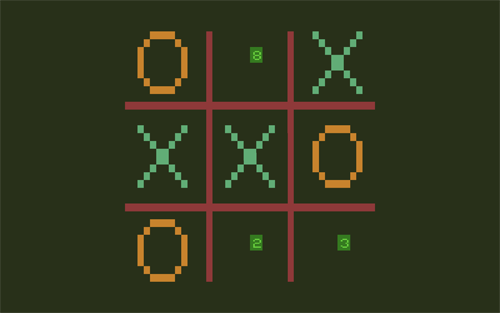
Despite this trio of games getting the Teary TP award for its lack of quality, make no mistake about it - this is may contain the best video game variation of hangman that I've ever played. Unfortunately, it also has some awful games to drag the whole cartridge down. I'll start with Hangman. Hangman has a few options, where you can focus on smaller words, larger words, or small and large words all combined together. As you play, you'll also get a man slowly appearing on screen for each miss. If you fully build the man by missing enough, you'll see the fellow dangling there by his neck, with his face purple…so you'll know that your lack of an education is what killed that poor soul. The display on the screen and the large man being hung are pretty impressive for its time - everything looks nice and the game is easy to understand, with plenty of words, big and small, to try to decipher. This is a good video game adaptation of the pen-and-paper game. And it's all downhill from there. After that you've got two variations of Tic-Tac-Toe - one for playing against a friend and one for playing against the computer. Neither one is particularly fun, especially not any more fun than if you had played this on a piece of paper instead. Last, and least, is Doodle. Doodle isn't the only "drawing" game of the time, but it is definitely the worst one I've personally played. The only thing making Doodle different from an Etch-A-Sketch is that you can change the color of the line that you're creating. The game is so bad, however, that even though it doesn't erase the image on screen, you may be violently shaking your MP-1000 console while playing this out of frustration of what kind of awful mess you were given on this cartridge. Instead of Doodle, it should be called Doodie, since this game is a big, ol' pile of poo. Overall, if you like playing hangman, then this cartridge is worth a purchase…I wouldn't bother with anything else on here, though.
Hangman
Tic-Tac-Toe
Doodle

Review added: 12/18/2025
Pinball / Dungeon Hunt / Blockout
Also known as: N/A
Developer: APF Electronics
| My Score | Avg. Score | ||||||
| 4.0 | 4.7 | ||||||
| Release Dates | |||||||
|
|||||||
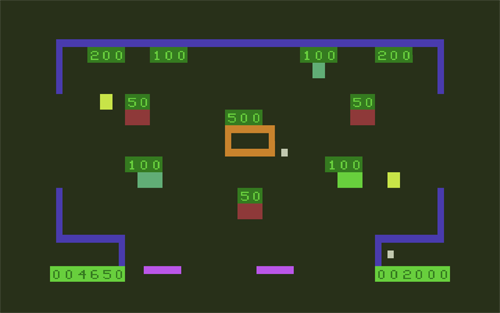
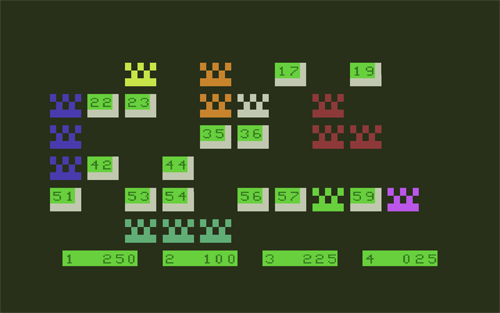
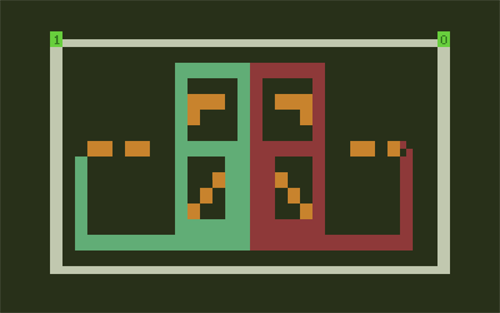
Well, this is another sub-par trio of games for the APF Microcomputer. I suppose I'll get right to explaining about everything here. Despite its name, Pinball is not a game of pinball. Like Gee Bee in the arcades, it's an attempt to mix pinball with Breakout…unlike Gee Bee, though, it's not very fun at all. There are no blocks to remove, but you're just moving the paddle(s) left and right to get the ball to continue bouncing around. While it can be mildly fun, it also has quite a few problems - the biggest one being the lack of any realistic physics. It's not uncommon to have a ball hit something at an angle that should propel the ball diagonally and instead, the ball moves straight left and right or up and down. The big issue with that is that you don't just lose a ball from missing it with your paddle(s) at the bottom of the screen. The sides of the screen also have gaps. If the ball enters those gaps, you lose it. The end result is that the game feels very, very cheap much of the time when you've got the ball moving and you're obtaining points…and then the ball ignores all physics and simply rolls right off of the side of the screen. Some more polish, and some better physics could have saved this game, but this is a game of pinball that you'll want to avoid. Next is Dungeon Hunt…basically, you and three other players take turns picking numbers on the screen. If you reveal a colored pattern, you gain points and are allowed to pick again until you pick a number with nothing behind it. After all numbered tiles are selected, the person with the highest score wins. It's about as exciting as it sounds - which is not much at all. Last is Blockout. One would think that it may be a Breakout clone…but instead, it's a clone of Surround or Checkmate…or whatever you'd like to call it. Essentially, you and another player control a "snake." As you move, it leaves a trail behind it. If you or the other player touch any of those trails, it's game over. The goal is to try to trap your opponent so that they are forced to crash before you. It's a mildly fun game, though this version does feel like it's lacking compared to the other two that I mentioned. Still, though, it's the best game on this cart…even if it's still a bit sub-par itself. Ultimately, some of the games here show promise, but nothing here is really worth playing. Instead of playing Dungeon Hunt, for example, you should probably be hunting for a better cartridge to play.
Pinball
Dungeon Hunt
Blockout
Review added: 12/21/2025
Rocket Patrol
Also known as: N/A
Developer: APF Electronics
| My Score | Avg. Score | ||||||
| 4.0 | 4.3 | ||||||
| Release Dates | |||||||
|
|||||||
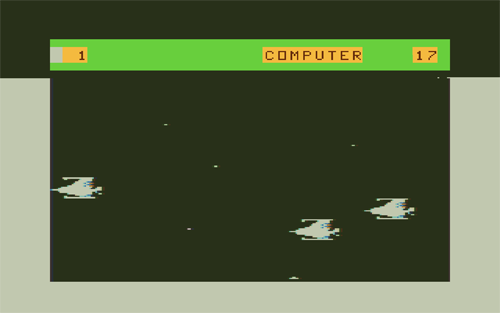
Rocket Patrol was the included game for the APF Microcomputer System when you purchased it…and I think APF "pooped the bed," as the kids would say, with that decision. Usually games bundled with a gaming device are games that are either very fun, very well done, or show off the capabilities of the machine. The only thing Rocket Patrol may have showed me is that it seems like it can handle more graphics on the screen, and with more detail, than the Atari 2600. It also shows that better graphics don't automatically translate to more fun. Basically, Rocket Patrol is either a one player or two player game. I'll go over the two player game first. Each player is given one minute to shoot as many ships on screen as possible. The catch? The ships are often moving at a decent pace…well, at least, compared to the shots you fire. When you fire a missile at a ship, that missile moves at the speed of a sloth that eats sleeping pills like candy. As a result, you're not really firing at specific ships (unless you go all the way to the left of the screen and try to time your shots there) as much as you're just shooting molasses missiles out and hoping that one of the ships pass by and drive into it. After thirty seconds, the ships pass by at a faster pace, making them "more difficult" to hit…or easier for them to fly into your missiles, depending on how you look at it. The player with the most ships shot down is the winner and crowned the king of Rocket Patrol…and not a single person on the planet will acknowledge your royalty from that day forward. If you play this game solo, it's more of a chore…you aren't just shooting for practice, you're playing against a computer opponent. The computer always goes first, so if you want to play this game by yourself, you'll be watching the computer shoot away for a minute before you get your chance. The catch here is that the computer is handicapped - its firing station can't move left or right like yours can. I'd imagine that rather than watch the computer play for a minute, most folks playing solo would just select the two player game and play as both players instead. That's a logical choice. Another logical choice would be to put the APF M1000 Microcomputer in the corner to think about what it's done, while you plug in an Atari 2600 instead.
Review added: 12/18/2025
Space Destroyers
Also known as: N/A
Developer: APF Electronics
| My Score | Avg. Score | ||||||
| 7.5 | 7.1 | ||||||
| Release Dates | |||||||
|
|||||||
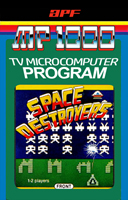
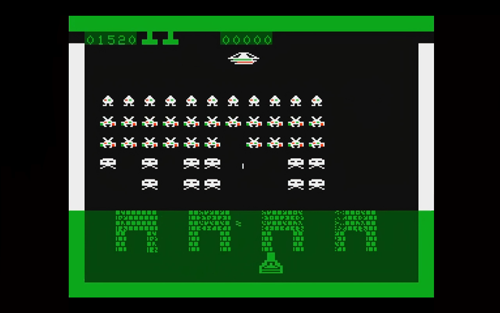
It's kind of telling that the absolute best game available on the APF MP-1000 is a clone of a successful arcade game. As you likely guessed by the name and by the screenshot, this is a clone of Space Invaders…and by clone, I mean there's not really a whole lot here that's different than what you'd find at the arcade. That's a good thing and a bad thing, in my opinion. It's bad in the sense that there's no really any innovation here - just a blatant rip-off of a successful game. Granted, this game does look better, and it doesn't require you to pop in a bunch of quarters to play, but it's still a rip-off without any really gameplay innovations. In comparison, when Atari released Space Invaders on their Atari 2600 console, it didn't look as nice as it did in the arcade, but it had countless variations and modes to keep even the players who had spent hours at the arcades entertained for hours at home. Still, despite it simply being a better-looking clone, Space Destroyers is still well-done and, as I mentioned at the start, the best game that you can get on the MP-1000. I believe it was also the last game made for the console, so at least APF's ill-fated console went out with its head held high…well, kind of. It's kind of like copying off of the smart kid at school, then gloating about getting a good grade. Sure, you got a good score, but can you really feel good about it? Maybe APF didn't, and rather than have their head held high, they hung their head in shame….either way, they closed out their library with a decent game, regardless of how they got there. Man, I "destroyed" the close of this review, didn't I?
Review added: 12/21/2025
UFO / Sea Monsters / Break it Down / Rebuild / Shoot
Also known as: N/A
Developer: APF Electronics
| My Score | Avg. Score | ||||||
| 3.5 | 4.3 | ||||||
| Release Dates | |||||||
|
|||||||
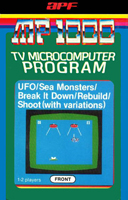
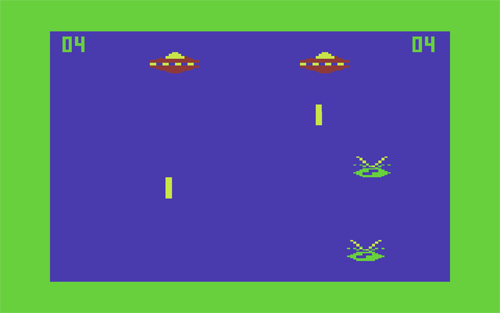
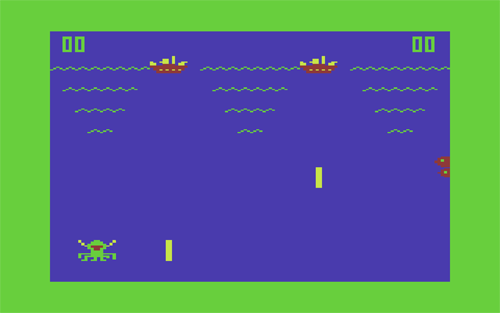
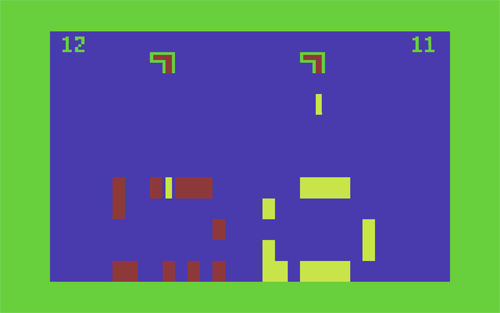
What do flying saucers, monsters of the deep, making walls appear and disappear, and making block colors changes via the use of laser beams have in common? Give up? They all resulted in their own poor third-person shooter game that fit on a single cartridge…this awful cartridge. In fact, if you're looking for a collection of sub-par shooters, then APF Electronics had you covered with this awful compilation of games. Let's get to describing them, I suppose. First is UFO…a game where you and another player control UFOs at the top of the screen. You fire down at the other alien aircraft and the goal is to have the most points by the end of the game. Shooting the alien aircraft at the top of the screen is worth one point and the aircraft at the bottom of the screen is worth five points. Next is Sea Monster, which has an "s" at the end of the name on the box art. which is the same as UFO except for one catch - the sea monster at the bottom of the screen is your target. Hitting it nets you five points. If you hit the fish swimming on the upper part of the screen at any point, your score drops to zero. It makes the formula more interesting, but both UFO and Sea Monsters are about as fun as sticking the handle of a fork in one of your nostrils while simultaneously sticking the pronged end in an electrical outlet….okay, maybe slightly less fun than that. Next is Break it Down and Rebuild…basically two of the same game, just reversed from each other. In both games, the goal is to use as few shots as possible to accomplish your goal. In Break it Down, you've got a box at the bottom of the screen, and your goal is to shoot all walls of that box away. Rebuild is the opposite, with an invisible box at the bottom of the screen, and as you shoot, you make the walls visible. These are the games that are the closest to what I'd consider to be passable on this cartridge, and if the entire cartridge was devoted to fleshing out and expanding on the idea of these games, they may be passable. Unfortunately, for what they are, they're a bad game that look good because of the company they keep on the cart. The last game is called Shoot…and that's what I said when I was told that I had to play it, "Awwww, shoot!" If I had a vulgar mouth, I would've used a second word instead…and that word is a better description of this game, honestly. Shoot is a game where you shoot lasers at a pair of blocks bouncing around back and forth at the top of the screen. Each time you hit the blocks, they change colors and/or speeds and you get points. The catch is that you've got a limited number of shots, so the goal is to get as high of a score as you can before running out of shots. Or, for most people, the goal of the game will be to figure out a way to power down the console as fast as possible so you don't have to play anymore. Ultimately, nothing on here is worth playing. The best thing to do with this cartridge is to pour some cement in the casing, then throw it in a nearby body of water…like Sea Monsters, let this awful compilation sleep with the fishes.
UFO
Sea Monsters
Break it Down / Rebuild
Shoot
Review added: 12/21/2025